
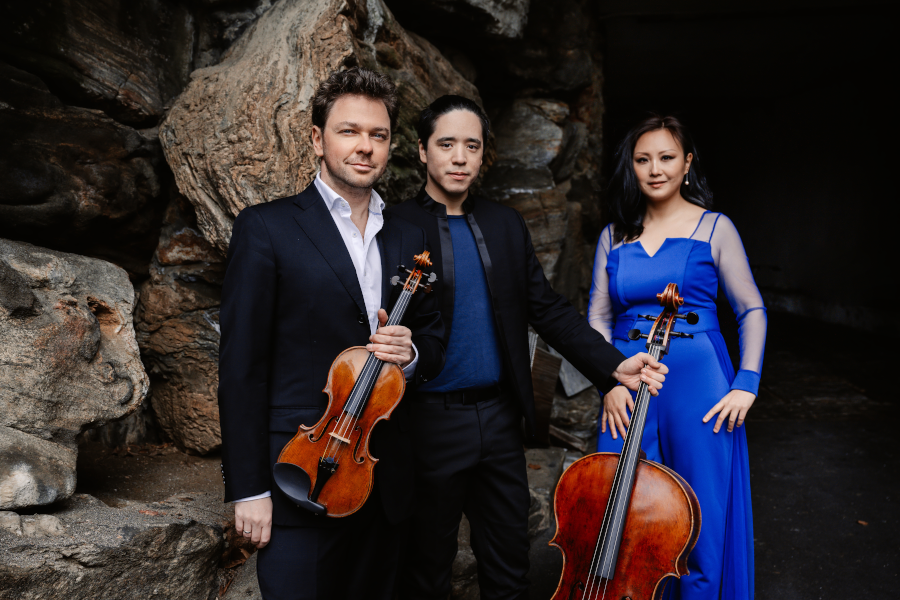
The Sitkovetsky Trio’s concert will present well-known and frequently performed works by Ludwig van Beethoven and Johannes Brahms. The counterpoint will be a less popular, yet definitely worth exploring, composition by French artist Cécile Chaminade. The featured trio is led by the distinguished British violinist Alexander Sitkovetsky, artistic director of the NFM Leopoldinum Orchestra. He is joined by German cellist Isang Enders and Chinese pianist Wu Qian.
The evening will begin with the Piano Trio in D major op. 70 no. 1, known as the “Geister-Trio” (“Ghost Trio”). It is considered one of the most enigmatic pieces in Ludwig van Beethoven’s oeuvre. He wrote it while working on his symphonic masterpieces, the Fifth and Sixth Symphonies. The origin of the peculiar subtitle is not entirely clear, but scholars link it to an unrealised project of writing an opera, Macbeth. In the slow movement, Largo, the composer is said to have drawn on sketches originally intended for the operatic score, which was never to be completed. The second piece on the programme will be the Piano Trio No. 2 in A minor by Cécile Chaminade, who achieved fame and esteem as a pianist and composer, and in recognition of her achievements, the French government awarded her the Legion of Honor in 1913. Her extensive oeuvre includes around four hundred works in Romantic style – including instrumental concertos, songs, a symphony, a ballet, a comic opera, and numerous piano works. The trio we will hear is an early composition, completed in 1887.
The second part of the concert will feature Johannes Brahms’s Piano Trio No. 1 in B major op. 8. The German composer completed it in January 1854, at the age of just twenty. The premiere took place a year later in Gdańsk. However, the composer was not entirely satisfied with the work – he returned to it over three decades later and thoroughly reworked it. It is this revised version that is widely performed today. Composed of four movements, it is extensive and can be described as paradoxical: monumental and intimate at the same time. It contains, especially in the second movement, distant echoes of Felix Mendelssohn.