
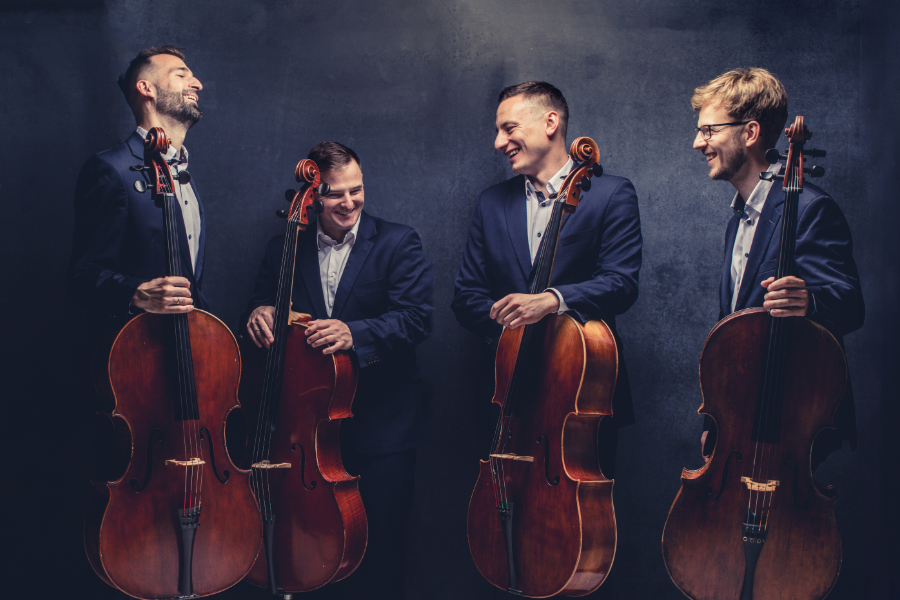
The Polish Cello Quartet’s programme will combine works by composers from Poland, Sustria, and Italy, whose biographies show that consistence in pursuing musical passions may bring unexpected twists and turns. These pieces will be played along the cellists’ own arrangement of the canonic Suite in Old Style op. 40 “Aus Holberg Zeit” by Edvard Grieg. In this work the Norwegian composer married reflections on Baroque conventions with Romantic expression.
The concert will open with a work by a Polish artist whose oeuvre has all but fallen into oblivion in our country. Ludomir Michał Rogowski, born a year before Karol Szymanowski, like Szymanowski, studied composition with Zygmunt Noskowski. His other music professors included Roman Statkowski, Emil Młynarski, Arthur Nikisch, Hugo Riemann, and Jan Reszke. Although thoroughly educated, Rogowski did not find his place in the pre-war Poland’s cultural life. In 1926 he migrated to Dubrovnik, then part of the Kingdom of Serbs, Croatians and Slovenians. It was a breakthrough, and from then on he would never leave the Adriatic coast. Born in Vienna in the early 19th century, Franz Limmer also migrated to the south. Having earned a renown as musician and composer in the Austrian capital, he was offered the post of conductor in the German Theatre in Timişoara in today’s Romania, then part of the Austrian Empire. The artist accepted the job and lived there until his death in 1857.
Emanuele Gianturco did not study music, instead he chose law, pressured by his parents, and got involved in politics, which took him to the Italian parliament, where he advanced to the position of deputy speaker. Ministerial portfolios in the Italian Kingdom’s government crowned his career. Although he devoted his life to public service, Gianturco wrote music all along, including the Cello Quartet chosen for tonight by the Polish Cello Quartet. The From Holberg’s Time Suite, closing the concert, was written on the occasion of Ludvig Holberg’s bicentenary falling in 1884. This Enlightenment writer was celebrated as the father of Danish theatre but was also a historian and political thinker. Grieg’s work is most popular in its score for string orchestra. Yet originally it was written for piano. Thanks to the Wrocław-based artists we will listen to it in a new, chamber version for four cellos.
