
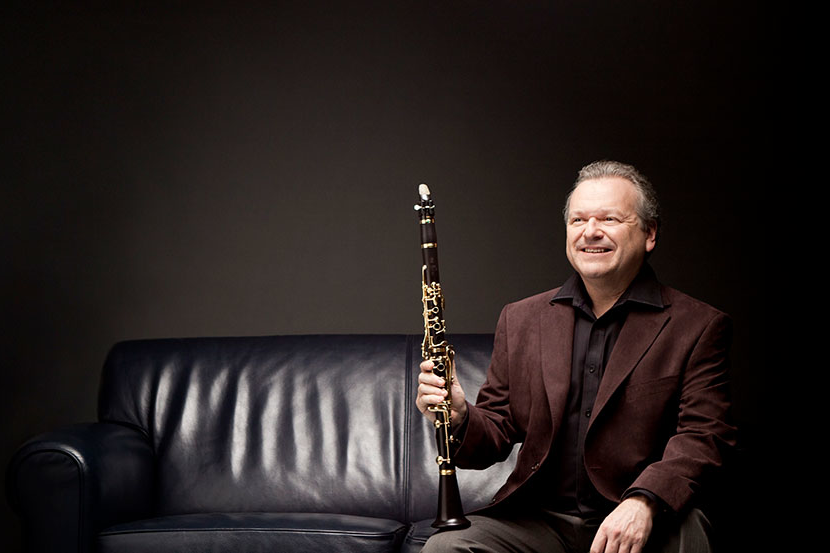
The NFM Leopoldinum Orchestra’s collaboration with two clarinetists, one of whom is also a renowned conductor, offers enormous scope for repertoire selection. The programme for the next concert in the Better Together series will therefore juxtapose an often-overlooked piece from the work of the Romantic composer Felix Mendelssohn with the pulsating rhythms of a piece by contemporary artist Elena Kats-Chernin. We will also hear works by Edvard Grieg, Benjamin Britten, and Aaron Copland. The guest artists will be Michael Collins and Pablo Barragán.
Kats-Chernin’s Zoom and Zip dates from 1997 and premiered in 1998. This sonically expressive composition is based on the rhythmic complementarity of the melodic and accompaniment layers. The composer admits to being inspired by the sonorities characteristic of music by Russian composers – in this way, she returns to the country where she grew up. She was born in Toshkent, today’s capital of Uzbekistan (then a republic of the USSR), and studied in Moscow before settling in Australia. The first work for clarinet to be performed this evening will be Aaron Copland’s Clarinet Concerto. It is one of the most famous pieces of its kind written in the 20th century. Its first performer was the renowned jazz musician Benny Goodman. Yet even for him, the work proved too difficult, and he decided to make it simpler.
The Konzertstück (op. 114) was written for clarinetists Heinrich and Carl Baermann. Both father and son were friends of Mendelssohn, and Carl was also an excellent cook. The German artist promised to compose something for them both if Carl Baermann cooked for him. Mendelssohn’s wish was granted, and the musicians were gifted two Konzertstücke in 1832 and 1833.
The second part of the evening will begin with the well-known Suite in Old Style ‘From Holberg’s Time.’ Edvard Grieg completed it in 1884. The bicentenary of Ludvig Holberg’s birth – a Norwegian and father of Danish theatre – was celebrated at the time. Grieg thus created a stylisation of Baroque dance forms. Despite intending to imitate the conventions of the 17th century, he infused his work with elements of typically Romantic sentimentality.
At the end, we will hear a composition by Benjamin Britten. In 1937, Boyd Neel asked him to write a new work for string orchestra. The conductor was scheduled to perform at the Salzburg Festival – a premiere was required – so he turned to the twenty-four-year-old Britten, as the two had previously collaborated. Within a month, Britten prepared the complete score of the Variations on a Theme by Frank Bridge. The composer freely developed the concept of his mentor and teacher, Frank Bridge, sometimes parodying classical forms.