
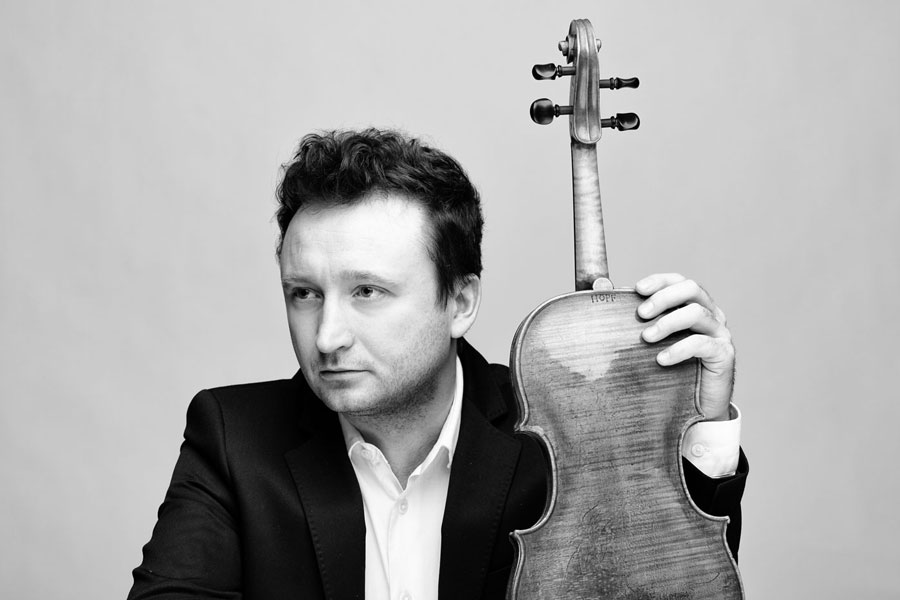
Poland’s Galicja is not just a point on the map, but also a space of memory of several nations and their histories. Inspirations from Jewish, Ukrainian, and Polish traditional music weave the concert’s repertoire into a story about it as a meeting place of cultures. During the concert, we will be led from salon miniatures to operatic arias and Carpathian folk inspirations. Performers include soprano Olena Herneha, violinist Radosław Pujanek, pianist and autor of the concept Andrea Linsbauer, joined by actor Mariusz Bonaszewski.
The evening will open with two works by Poles who gained fame as performers. Henryk Wieniawski was one of the most celebrated virtuosos of his era, composing mainly for violin. Chanson polonaise in G minor is a melancholic salon miniature set in the rhythm of a mazurka. Emil Młynarski also drew on the idiom of this dance in the serene Mazurka in G major. Today, Młynarski is remembered as a brilliant conductor and promoter of Warsaw’s musical life in the early 20th century. Franz Xaver Wolfgang Mozart reminds us that Galicja was also a meeting place for great names. Wolfgang Amadeus’ son, he worked in Lviv from 1813 to 1838 as a teacher and pianist, earning the “Mozart of Lviv” nickname. The programme includes his song Le Baiser op. 21 no. 6 – a graceful miniature.
Born in Podolia, western Ukraine, Anton Rubinstein was one of the most distinguished pianists of the 19th century. Although he left us operas and piano concertos, his lyrical Melody in F major – a simple yet incredibly evocative piece – achieved the greatest popularity. The first part of the concert will conclude with music by Ukrainian composers. Mykola Lysenko, the father of Ukrainian national opera, will be represented by an excerpt from Natalia Poltavka. The Romantic tradition will also be reflected in a fragment from Semen Hulak-Artemovsky’s work – a monologue by Oksana from Zaporozhets on the Danube. After the break, we will listen to Myroslav Skoryk’s Carpathian Rhapsody, which resonates with folk melodies from the Carpathian Mountains. This music is rooted in landscape and tradition. From the works of Lev Kolodub, born in Kyiv, the musicians have chosen The Cuckoo Called and My Beloved Went to the Mill. George Perlman was born in Kyiv and emigrated to the United States as a young man. He retained a strong bond with his native tradition – an expression of which is the Israeli Concertino, and at the NFM we will hear Nocturne, the second movement. The programme also features I Don’t Want to Sleep by Oles Tschischka, composer and singer. The evening’s finale will resound with Two Pieces for Violin and Piano op. 20 by Joel Engel, an artist and renowned researcher into Jewish folklore.