
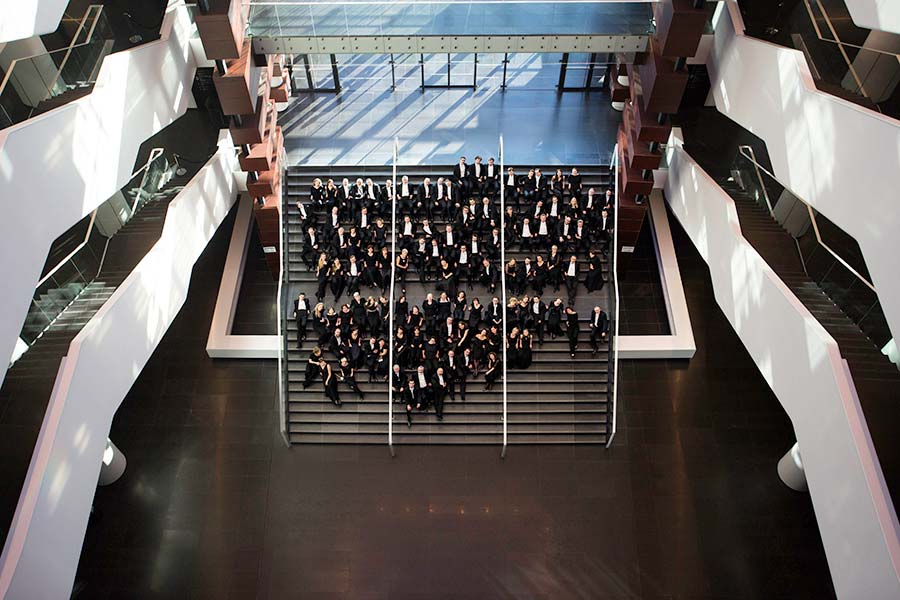
Who else but the NFM Wrocław Philharmonic could perform at the concert that would conclude 2025 and usher us into the next? Celebrating its eightieth anniversary, the orchestra is preparing something special for this special evening, symbolising the end of the old and the beginning of the new. The programme will include dances composed by members of the Strauss family, as well as songs and excerpts from various operas. We will hear wonderful singers – Mojca Erdmann, Agnieszka Rehlis, and Matthias Goerne, conducted by Ruben Gazarian.
The transition to the New Year has been celebrated since ancient times, and already then it was combined with lavish celebrations and the offering of gifts to ensure the prosperity of what was to come. Yet the new year celebrations in the ancient era fell on a different date. The festivities we still observe today began with the introduction of the Julian calendar at the behest of Julius Caesar in 45 BCE. The name of 31 December derives from Pope Sylvester I, who is commemorated on this day in the liturgy of the Roman Catholic Church. His death on December 31 became a symbol of the end of an era. With the popularisation of the Gregorian calendar in the 16th century, the last day of the year gained special significance as a moment of reflection on the passing of time and anticipation of a new beginning. The NFM tradition is to adorn this moment with music.
During the concert we will hear works by Josef Strauss and his more famous brother Johann Strauss II. We will also hear works by Richard Strauss, a great German composer, unrelated to the Viennese dynasty. Although best known today as a master of opera and symphonic poems, he also composed songs. The key to their choice for this night is the timeless theme of love. The same motif can be found in Franz Schubert’s An Sylvia and Des Fishers Liebesglück The Austrian artist has given musical form to the German translation of Shakespeare’s early comedy, The Two Gentlemen of Verona, a study in the conflict between the passions of the heart and friendship. We will also travel to Venice, listening to the aria Voce di donna o d'angelo from Amilcare Ponchielli's most famous opera, La Gioconda, written to a libretto based on Victor Hugo’s drama Angelo, the Tyrant of Padua. The Milan premiere of this work was such a success that for a short time, its composer was considered a successor to the aging Verdi. However, it quickly became clear that the then sixty-two-year-old Verdi still had plenty of creative energy and no successor was needed. His oeuvre this evening will be represented by the aria Stride la vampa from Il trovatore. Shortly afterwards, we will return to Vienna, to listen to Wolfgang Amadeus Mozart’s aria Alma grande. The programme will be complemented by the popular Mon cœur s’ouvre à ta voix from Samson and Delilah – a gem of French opera penned by Camille Saint-Saëns.