
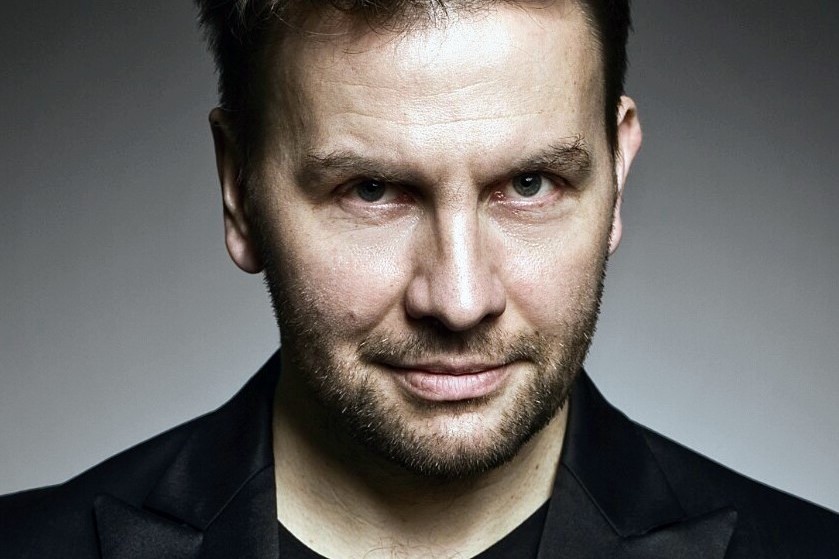
The final chamber concert of the NFM season will feature baritone Bartłomiej Misiuda and pianist Michał Rot. The artists will perform three song cycles created over six decades by two distinguished composers – Robert Schumann and Gustav Mahler. In different ways, they speak of a sense of alienation, as well as transcendence and metaphysical longing. These commotions of the spirit, characteristic of the Romantic era, are no strangers to us, as we struggle to navigate our way through a time of technological acceleration.
Lieder eines fahrenden Gesellen is a work born from Gustav Mahler’s unhappy love for the singer Johanna Richter. Written between 1883 and 1885, these four pieces, with lyrics by the composer, fit the Romantic theme of travel as an escape from heartbreak and a search for existential sense. Reality blends with fiction, and the protagonist’s experiences are reflected in images of nature. The first song juxtaposes the mood of a wedding with the despair of a spurned lover. The second brings a momentary delight in the world but ends in bitter resignation. The third is a dramatic culmination of suffering, compared to a red-hot knife plunged into the chest. And the cycle concludes with an elegiac farewell when the wanderer finds peace under a linden tree. The work is a poignant study of melancholy – the quintessence of the Romantic Weltschmerz. Two decades later, at the dawn of the 20th century, Mahler became drawn to the work of Friedrich Rückert, an esteemed expert on Asian cultures at the time. As a result, between 1901 and 1904, a collection of five Rückert-Lieder was composed, and the composer later drew on the scholar’s poetic texts while composing the Kindertotenlieder. In this cycle, the author departs from folklore, turning to metaphysics and introspection. He combines various moods. Liebest du um Schönheit is a conventional love song. Ich atmet' einen linden Duft is a striking suggestion of a synesthetic perception of reality. Blicke mir nicht in die Lieder is a moving commentary on the intimacy of the creative process. Ich bin der Welt abhanden gekommen is considered a masterpiece, reiterating the issue of the artist’s alienation. Um Mitternacht, placed at the end of the set, provides religious solace.
Liederkreis op. 39 was composed in 1840 – a time dubbed the “year of song” by Robert Schumann’s biographers. Most of the works written at that time – a prolific period in his life – were in this genre, including the brilliant works from Frauenliebe und Leben and Liederkreis. In creating the latter, Schumann found inspiration in the poetry of the Silesian poet Joseph von Eichendorff, born near Racibórz and buried in Nysa. It is one of the most perfect embodiments of German Romanticism. The cycle consists of twelve songs that paint an atmospheric panorama – from a dark forest, through castle ruins, to an ecstatic awakening of spring. Frühlingsnacht, which crowns the cycle, is interpreted as a reference to Schumann’s personal happiness, as he was already awaiting his marriage to Clara Wieck (against the wishes of her father).