
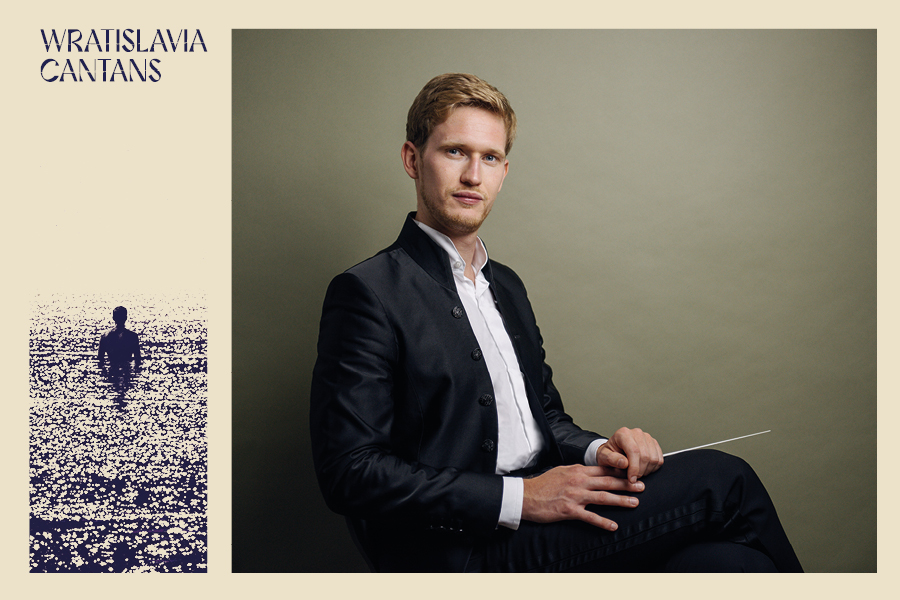
When he began work on the opera that will open the 61st International Festival Wratislavia Cantans, Camille Saint-Saëns had already reached the “age of Christ”– thirty-three. In Samson et Dalila, this symbolic crossing of a line by the composer is parallel to the message of the libretto. The mighty Samson – the biblical equivalent of Heracles – sows terror among his enemies but is himself overcome by the power of passion. Finally, he discovers that the only way to reveal true heroism is through self-sacrifice. During the concert, the parts of the protagonists will be performed by singers Nikolai Schukoff and Anita Rachvelishvili, and the NFM Wrocław Philharmonic will be conducted by Thomas Guggeis, music director of Oper Frankfurt.
Saint-Saëns’s in the beginning wanted to present the story of Samson and Delilah as an oratorio, a genre devoid of stage action. He was persuaded to change his mind by the poet and author of the libretto Ferdinand Lemaire. The composer, following the example of Rossini and Verdi, who also drew on biblical themes, chose the form of an opera. It was an excellent move. Saint-Saëns found in the events described in the Old Testament tensions worthy of the best Italian patterns or the works of Richard Wagner, and in the title character a full-blooded dramatis persona with a complex psyche. The story of a warrior possessing superhuman strength enabled him to contain in the score things that appealed to French tastes: a dance scene, stylisations suggestive of Middle Eastern music, and a spectacular finale.
The composition took a long time to complete. Although Saint-Saëns had already performed Act II at a private audition in 1868 (without gaining approval), his participation in the Franco-Prussian War and the events of the Paris Commune prevented him from continuing work. Subsequently, he was more inclined to devote his time to other genres, but Franz Liszt pressed him to complete the opera, promising to arrange a production in Weimar. The work (in a German-language version) actually had its premiere there in 1877. The Paris Opéra waited fifteen years for the opera. When it was finally presented there, it was received with extraordinary enthusiasm. Consequently, Samson et Dalila remains in the repertoire to this day, and deservedly so.