
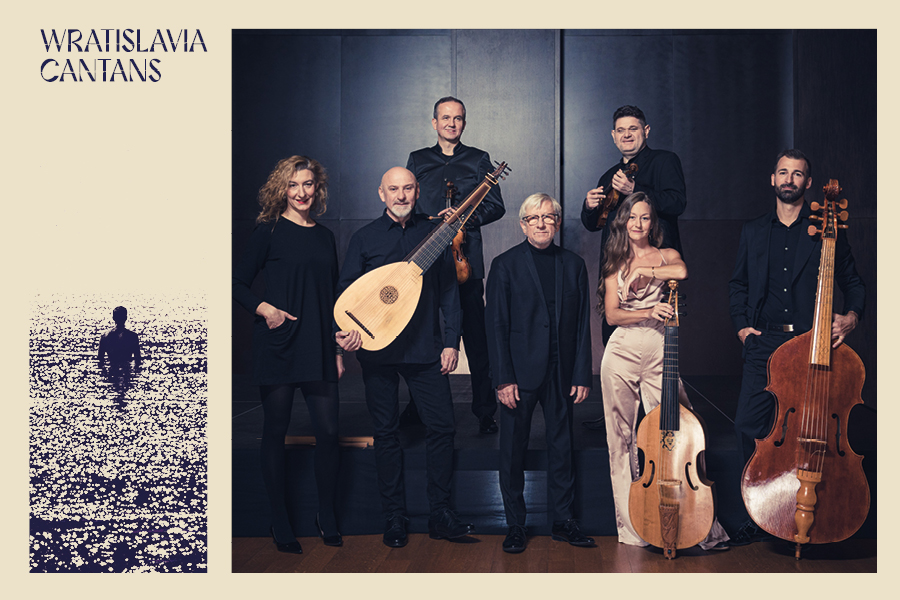
Is it possible to persevere in faith, virtue, and love, relying solely on one’s own spiritual potency? This question, regardless of one’s faith or lack thereof, has been asked and continues to be asked by many people guided by values in their lives. What is the purpose of our existence in this world? Johann Sebastian Bach did not know the answer either and perhaps that is why he composed. During this year's Wratislavia Cantans, the theologian musician’s cantatas will be performed by Andrzej Kosendiak and Giovanni Antonini, joined by soloists from the NFM Boys’ Choir and Wrocław Baroque Ensemble.
In some of his church cantatas, Bach used recorders (flauti dolci), whose sound was believed to connote pure, angelic or pastoral moods. This is the second time that the two artistic directors of Wratislavia Cantans – the previous and current one – will join forces in this repertoire. The collaboration between Antonini and Kosendiak will result in CD recordings of all of the Leipzig cantor’s works for recorder, released on Alpha Classics. The Wratislavia Cantans concert will feature three works performed in 1723 and 1724 at St Thomas Church. The pre-Lenten cantata, Gleichwie der Regen und Schnee vom Himmel fällt (Like Rain and Snow Fall from Heaven), tells the story of how God’s Word is “sown” on Earth. Interestingly, two recorders were added to the original version composed in Weimar. Perhaps the master wished to brighten the dark tone of the orchestra, devoid of violins – the effect can be seen in the opening sinfonia.
In Herr Christ, der einge Gottessohn (Christ, Lord, the only begotten Son of God), we also hear two recorders and in Es ist nichts Gesundes an meinem Leibe (There is nothing healthy in my flesh), even three! The former requires a flauto piccolo and a flauto traverso (transverse flute). The latter has a unique ensemble, as in addition to the cornett and oboes, three trombones appear. Their sound, contrasted with the recorders and flutes, is all the more conspicuous in the chamber ensemble. Despite this richness, the titular apostrophe is heard in the bass aria only with continuo accompaniment: “Du, mein Arzt, Herr Jesu, nur weißt die beste Seelenkur” – “You, my physician, Lord Jesus, alone know the best medicine for the soul”.