
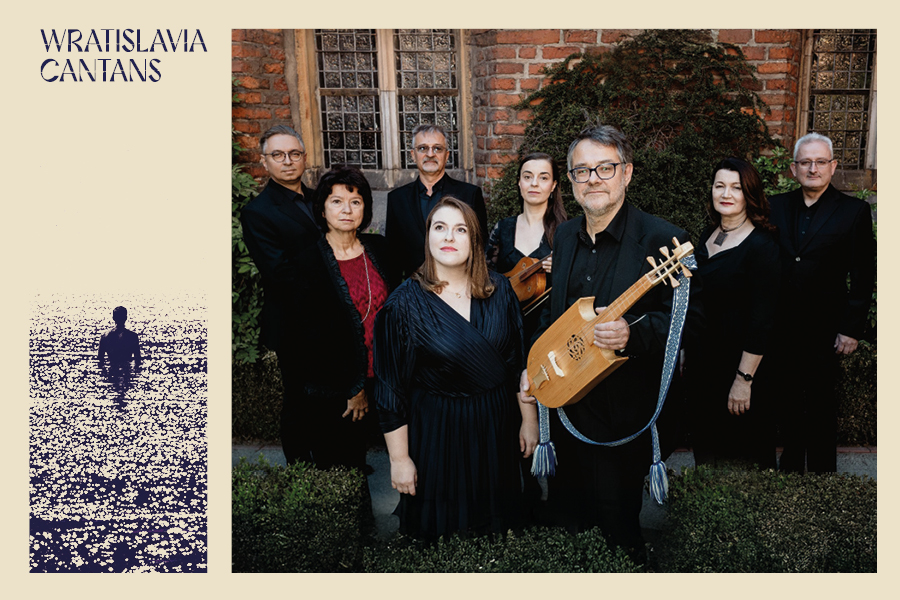
Active during the first decades of the Hundred Years’ War, Guillaume de Machaut was one of the greatest artists of the late Middle Ages. Despite the turbulent times, the composer and poet lived to an old age, dying in Reims at around eighty. The misfortunes ravaging the French lands were reflected in his works. At this year’s Wratislavia Cantans, the Wrocław-based ensemble Ars Cantus will present motets and ballads by the fourteenth-century master of polyphonic music. This will be Ars Cantus’s first concert as a main event of the festival.
De Machaut entered the pages of history as secretary to King John of Luxembourg of Bohemia. His principal was killed in 1346, siding with the French at the Battle of Crécy, a decision he made despite his complete blindness. The artist later established contact with the court of Bona of Luxembourg, the daughter of the fallen monarch. However, she too died shortly thereafter, most probably from the plague, which was decimating Europe at the time. The last of De Machaut’s patrons, Pierre I de Poitiers-Lusignan, King of Cyprus, was treacherously murdered in his own bed. De Machaut had earlier, in 1337, while the Bohemian monarch was still alive, accepted the prebend of Reims. Around 1340, as a canon of Notre Dame Cathedral, he settled in that city – he may have hailed from there, after all. Although his compositional career flourished during his residence at the Cité des Sacres, he was unable to escape the shadow of history. He witnessed, for example, Edward III Plantagenet’s attempt to capture the capital of Champagne (Geoffrey Chaucer, author of The Canterbury Tales, was among the besiegers) and the townspeople’s struggles with the Black Death. He later alluded to the plague in his song The Judgement of the King of Navarre.
Guillaume de Machaut’s motets, on which the performers will focus, is a continuation of the achievements of another medieval master, Philippe de Vitry. Both are considered the most prominent representatives of a progressive movement in 14th-century French music known as Ars Nova. It was characterised by the rise of polyphony and secular musical genres, new methods of notation, and above all, the use of isorhythmic technique, consisting of repeating rhythmic patterns (so-called talea) and melodic patterns (color) within a composition. Among the twenty-three surviving motets by the French master, the majority are three-part works, setting different texts. These pieces are the pinnacle of their time, combining mathematical precision of structure with extraordinary melodic inventiveness, and – on a semantic level – ubiquitous wordplay and the use of intriguing allusions. The fact that many of these qualities escape us while listening reflects the typically medieval belief in the superiority of music theory over performance. “He is therefore a musician who has undertaken the study of singing by reason, not in the service of practice, but by the power of speculation,” wrote Boethius in the 6th century.