
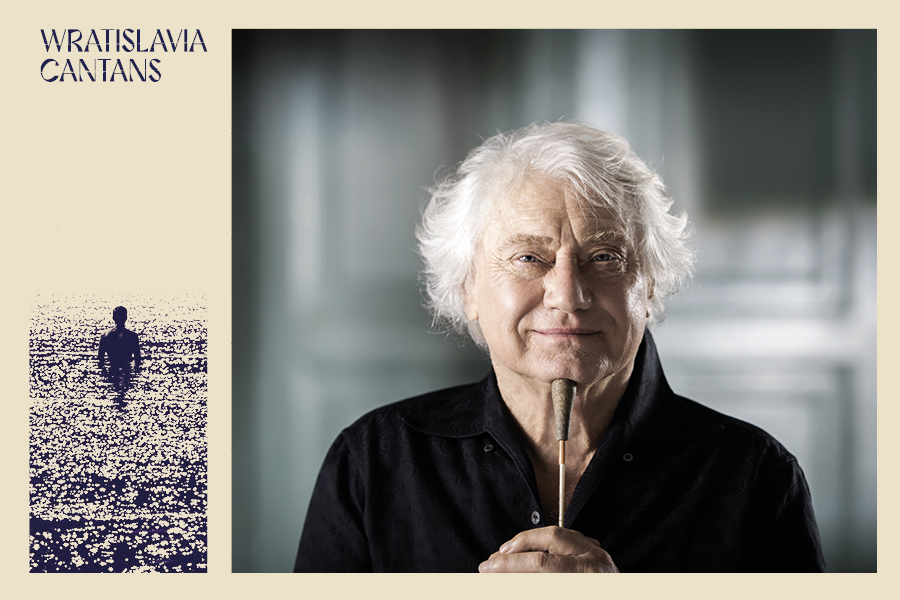
Jerzy Maksymiuk, esteemed for his immense liveliness and expressive interpretations, is celebrating a double milestone this year – the seventieth anniversary of work and ninetieth birthday. During the festival concert, under the baton of the distinguished conductor, the NFM Wrocław Philharmonic will perform compositions by Benjamin Britten and Claude Debussy, the latter particularly beloved by Maksymiuk. Then the instrumentalists will be joined by the NFM Choir to present Igor Stravinsky’s Symphony of Psalms.
The NFM Girls’ Choir and NFM Boys’ Choir will open the concert with Mikołaj Szczęsny playing the organ. Together, they will perform The Call of Wisdom by the English composer Will Todd, under the baton of Małgorzata Podzielny. The piece was composed also for an anniversary – it was commissioned for the 2012 concert at St Paul’s Cathedral and sounded during a thanksgiving service at St Paul’s Cathedral, celebrating the 60th anniversary of Queen Elizabeth II’s reign. Immediately afterwards, we will hear the symphonic poem La Mer, which captures the menacing beauty of the untamed element through the moods evoked in the music. Premiered in 1905, Debussy’s work dazzles to this day. In its opening, titled From Dawn till Noon at Sea, the French composer suggests the morning awakening of the natural world and the senses. It concludes with a luminous chorale marking the arrival of midday, “the moment of the shortest shadow,” as Friedrich Nietzsche described this important symbol. The next movement is The Play of the Waves, a vibrant scherzo. And Conversations between the Wind and the Sea is a clear foreshadowing of a storm.
The second part of the evening will begin with a presentation of Four Sea Interludes, also inspired by a maritime landscape. They come from Benjamin Britten’s most famous opera, Peter Grimes. The plot is set in a fishing village on the coast of eastern England. The composer decided to single out four excerpts from the composition, which, in their original arrangement, accompanied a change of scenery, to be performed as a separate piece. They evocatively depict dawn, morning, a moonlit night, and a storm at sea.
The concert will conclude with the Symphony of Psalms – Igor Stravinsky’s 1930 masterpiece, which stems from the sacred sphere. The artist set to music verses he chose from the biblical Liber Psalmorum. Referring to the form of the music suggested by the title, he explained that it was simply “a symphony in which he incorporated psalms intended for singing”. He claimed he intended “to symphonise the performance of the psalms”. The meaning of this enigmatic comment becomes clear when listening to the results of his work. The modern sound language used by Stravinsky fuses perfectly with ancient texts into an organic whole.