
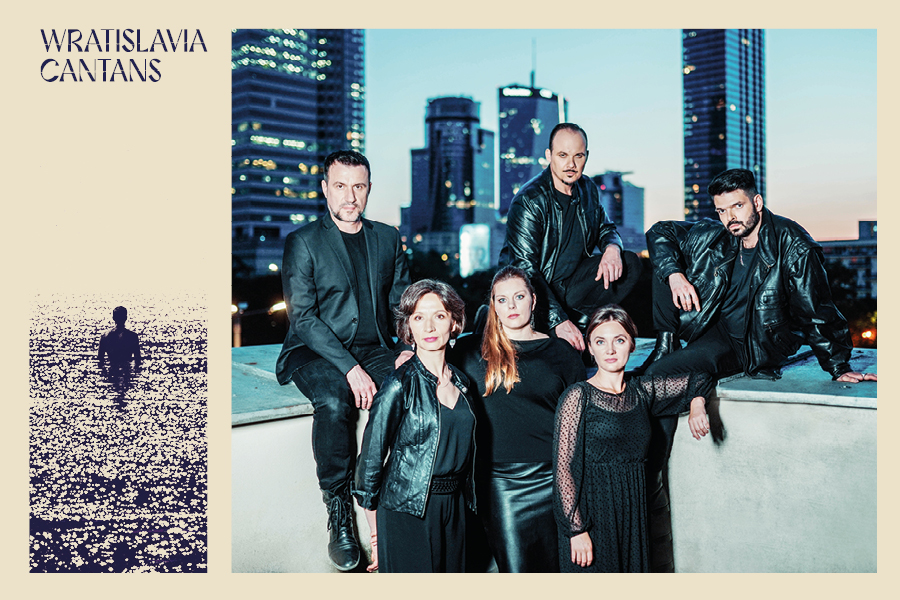

In 1925, radio-frequency electromagnetic field vibrations over the Republic of Poland for the first time transmitted signals sent by the national broadcasting station. Polish Radio was established. The concert by the distinguished proMODERN sextet, during Wratislavia Cantans, is part of the ongoing centenary celebrations of this memorable first broadcast. It will feature works by György Ligeti, Luciano Berio, and Agata Zubel, as well as the premiere of a piece by Aleksander Kościów commissioned by Polish Radio.
proMODERN specialises in contemporary music performance, which, during the avant-garde period, often employed a cappella line-ups. Singing proved to be a space for boundless experimentation. Ligeti and Berio are absolute classics of radical 20th-century compositional movements, although the works we will hear during the anniversary concert slightly approach postmodernism. Ligeti’s Nonsense Madrigals were written in the late 1980s. In them, the composer drew on the Renaissance madrigal genre, a socio-cultural phenomenon in its own right. Ligeti reflected the surreal, fairy-tale nature of the texts of Lewis Carroll and William Brighty Rands in his music. Written in 1976, Cries of London, was based not on poetic texts but on cries overheard by Berio while he was strolling through the London fairs. This doesn’t mean it lacks melody or meaning; on the contrary, the artist knew how to dramatize it brilliantly. Both works use the so-called extended vocal techniques, and both were composed for the same ensemble: The King’s Singers.
Before Ligeti and Berio, we will listen to more recent work. Wrocław-based Agata Zubel chose the same genre as Ligeti, writing Madrigals in 2015. Although she stripped it of its lyrics, she clearly hit specific keys on the emotional spectrum. Singing alone is, after all, an excellent conductor of emotional charge, let alone the singing of five people! Finally, Aleksander Kościów – a renowned, versatile Polish composer – was asked to prepare a premiere as part of the 10/100 project celebrating the centenary of Polish Radio. We will hear the by-definition unknowable “thing-in-itself” in the fifth composition from his Noumen cycle. The piece, “free from conventional formal necessities, flows smoothly through several identifiable segments, but rather not to begin again and triumphantly reach a psychologically obvious end.” Of course. In the latter case, it would be a transparent “thing for us”.