
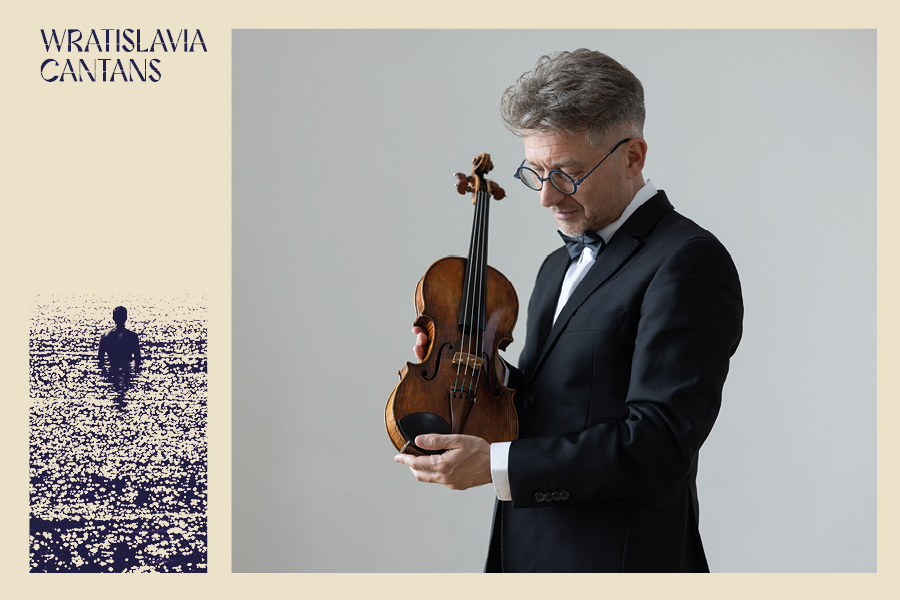
This year’s Wratislavia Cantans will feature a meeting of two violin masters: Alexander Sitkovetsky and Bartłomiej Nizioł. This will be not only a joint performance of extraordinary musicians, but also a fascinating dialogue of distinctive personalities. Rarely performed works by Georg Philipp Telemann, Henryk Mikołaj Górecki, and Sergei Prokofiev will be presented, and the programme will conclude with improvisations.
The evening will open with Telemann’s suite, a musical representation of the plot of Jonathan Swift’s famous Enlightenment novel, Gulliver's Travels, published in 1726. The German Baroque master, known for his extraordinary inventiveness and sense of humour, admirably translated the literary satire into the language of sound. Here, he demonstrates his rhetorical skills, utilising rhythm but also drawing on the symbolism of musical notation – the so-called Augenmusik. For example, the Chaconne, dedicated to the Lilliputians – the dwarfish protagonists of the novel – is composed in very small rhythmic values. The Gigue, on the other hand, referencing the gigantic inhabitants of Brobdingnag, is constructed in the opposite way – using only long notes. The Suite’s finale is a prime example of musical illustration: one section, melodic and calm, reflects the dignified Houyhnhnms, while the other, figurative, depicts the wild Yahoos.
Completely different from Telemann’s playful suite is Henryk Mikołaj Górecki’s Sonata for Two Violins op. 10. It was composed in 1957. There the dialogue between the two instruments is full of dense textures, sonoristic effects, and sharp dynamic contrasts. The work offers listeners a broad emotional spectrum. Above all, it creates the anxiety characteristic of the aesthetics of the Polish school of composition of that time. The Sonata in C major op. 56 by Sergei Prokofiev was born in 1932. As the composer admitted the idea came to him after hearing an earlier unsuccessful work for the same line-up, by an author whose name Prokofiev never mentioned. The four-movement piece poses diverse challenges to the performers and employs an immense wealth of expression. “Listening to bad music sometimes inspires good ideas,” Prokofiev remarked, recalling the situation.