
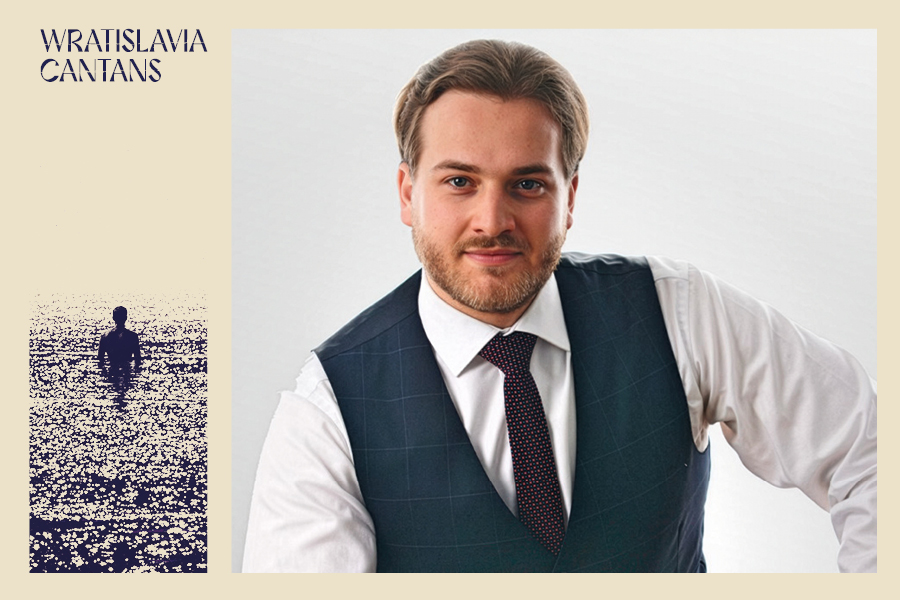
Andrzej Filończyk is a graduate of the Karol Lipiński Academy of Music in Wrocław, who, despite his young age, has already made his debut at New York’s Metropolitan Opera. The baritone also boasts a victory in the 2016 International Stanisław Moniuszko Vocal Competition (second place went to Jakub Józef Orliński), and in 2023, he received an International Opera Award, also known as the “opera Oscar”. At the NFM, the singer will be accompanied at the piano by Sasha Yankevych, a pianist and opera conductor. At the end of the recital they will perform excerpts from operas by Stanisław Moniuszko and Karol Szymanowski.
The first part of the evening will be devoted to lyric songs. The songs from Mieczysław Karłowicz’s early period are usually overshadowed by his mature symphonic works. They are an incredibly moving record of the young composer’s experiences. Among the poets to whose texts he composed, Kazimierz Przerwa-Tetmajer stands out. In the recital programme, the legacy of the Young Poland writer is represented by seven songs. In the works by this poet, a decade his senior, Karłowicz found moving depictions of existential disillusion and helplessness. These feelings were well-known to the sensitive student, then barely twenty years old, who had been rejected from József Joachim’s violin class and forced to take private lessons. As for the stylistic features of the compositions, they are quite conservative and fit into the early Romantic type of sonic language. Compared to the place occupied by lyric poetry in Karłowicz’s work, songs occupy a prominent place in Stanisław Moniuszko’s catalogue. One of the tasks undertaken by the father of Polish national opera was, after all, to create a broad repertoire for both professional singers and amateurs. These works were published in collections titled Śpiewniki domowe (Home Songbooks). They are particularly captivating with their flowing melodies inspired by folk culture and extensive use of Polish dance rhythms, which has led to the widespread belief that they constitute a kind of “quintessence” of Polishness, with Stanisław Moniuszko considered a creator of Romantic song in our culture.
The opera part of the recital will include fragments of Moniuszko’s works: Verbum nobile and Halka. The evening will conclude with the protagonist’s aria from Karol Szymanowski’s King Roger, staged for the first time a hundred years ago. The ruler of Sicily, left alone on the ruins of a Greek theatre, ascends the stairs, turns to the rising sun, and sings a hymn to nature, as Jarosław Iwaszkiewicz, co-author of the opera’s libretto, wrote of this fragment. According to Iwaszkiewicz, the conclusion of the story of the King and the Shepherd represents a symbolic “renunciation of hedonistic mythology” and the discovery of a new myth – the “myth of the earth”.