
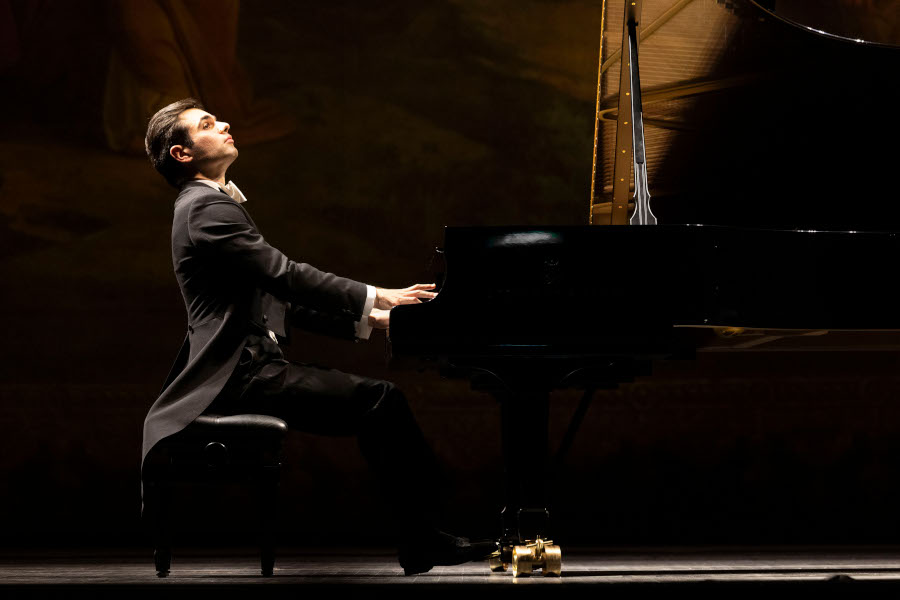
At the end of April, the distinguished conductor Anna Sułkowska-Migoń returns to Wrocław, and the French pianist Jean-Paul Gasparian will be at the NFM for the first time. He will perform the solo part of Johannes Brahms’s powerful Piano Concerto No. 1. In the second part of the evening, Sułkowska-Migoń will conduct Anna Thorvaldsdottir’s portentous and elegiac work and, for a contrast, Maurice Ravel’s exuberant opus.
Catabolism, in simple terms, refers to the breaking down of complex, high-energy chemical compounds into smaller particles, catastrophe denotes a disastrous set of circumstances, and the term “catamorphosis” can describe a transformation leading to destruction and fragmentation. Iceland’s Anna Thorvaldsdottir makes no secret of the fact that the inspiration for her Catamorphosis was humanity’s fraught relationship with its home – Earth. The scientific consensus (despite some skeptical opinions) is clear: the climate change we are now experiencing has been caused by humans, meaning our exploitative activities are to be blamed. In this moving and exquisitely orchestrated work, the artist meditates on the question of our agency. The title, referring to Richard Strauss’s Metamorphosen, places Catamorphosis in the tradition of musical narratives of decay. Yes, it is too late for some things – but not for all.
In the first part of the evening, we will grapple with the rebellious attitude of the young Romantic artist. On the day of the premiere of his Piano Concerto No. 1, Brahms was twenty-five years old. The protégé of Robert Schumann’s widow, he wanted to invoke his love for the famous pianist (the Adagio was intended as her portrait) through the work and gain the recognition of Germany’s musical elite. Hard to believe that the Leipzig premiere of this nowadays canonic work proved a failure. Ravel’s Spanish Rhapsody, which concludes the evening, will undoubtedly be a lighter, more Dionysian offering. In this work, the composer expressed his affection for Spain. Among the four movements, he included the Malagueña, which evokes the sensual character of Andalusian dance, and the Habanera, based on his earlier composition for two pianos. In 1908, when the Rhapsody was composed, the average temperature in the country south of the Pyrenees was over 2.5°C lower than today…