
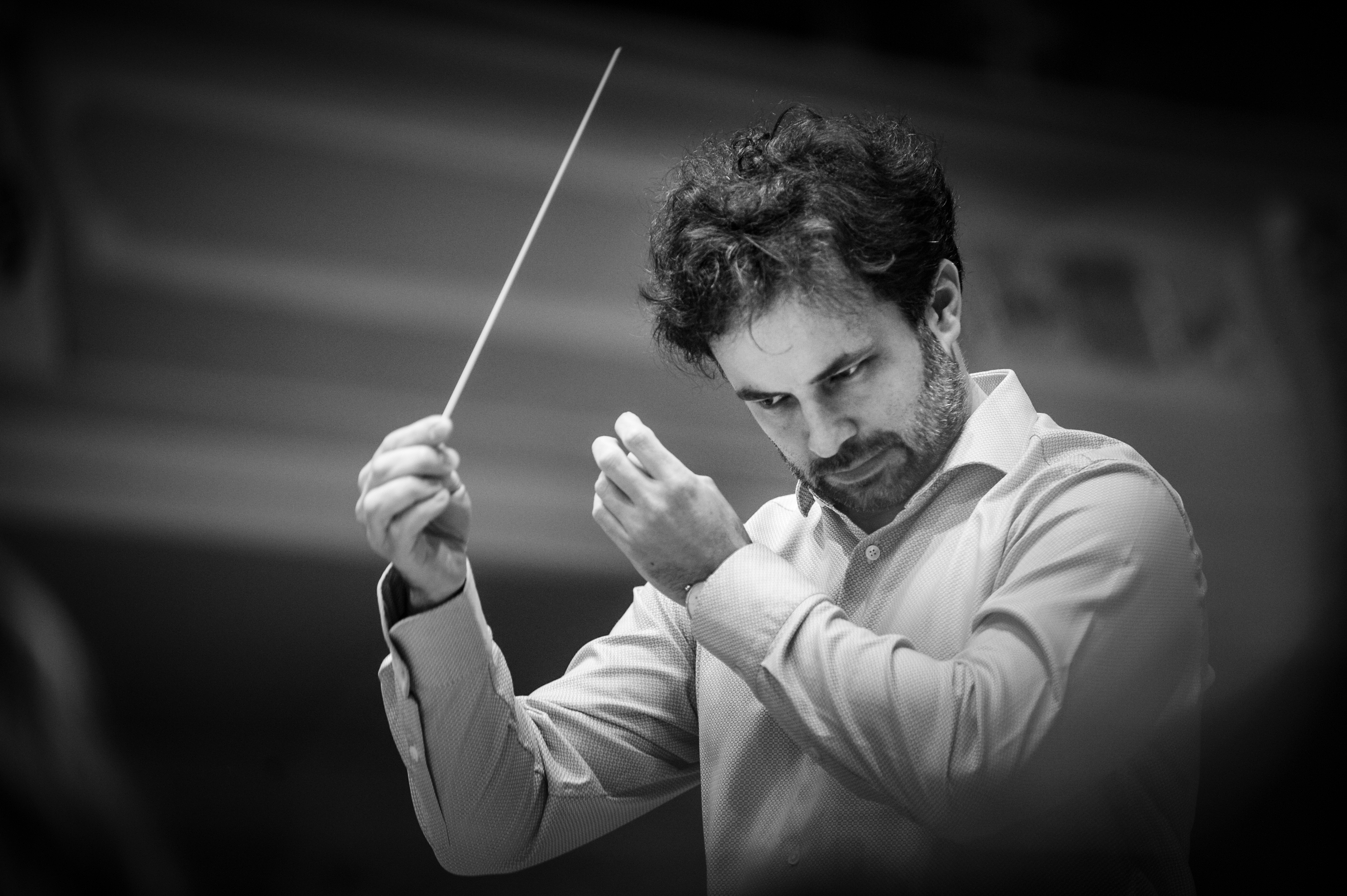
Exile, the loss of homeland, and the memory of those who have passed away – these themes form the basis of the concert programme for the NFM Wrocław Philharmonic, conducted by Łukasz Borowicz. In addition to works by Beethoven and Ravel, we will hear Jonathan Dove’s In Exile – a moving piece for cello, baritone, and orchestra, dedicated to Anita Lasker-Wallfisch. The solo parts in the Dove’s work will belong to cellist Raphael Wallfisch and his son Simon, a baritone.
Ludwig van Beethoven’s dark, dramatic, and tense Coriolan Overture was written in 1807. The composer drew inspiration from a tragedy by Heinrich Joseph von Collin, inspired by semi-legendary themes from the history of ancient Rome. Gnaeus Marcius Coriolanus – the protagonist – was a Roman general who, due to intrigue, was exiled from the Eternal City and joined the ranks of his former enemies, seeking revenge on his kinsmen. The composer based this movement on two contrasting musical themes – the first reflecting Coriolanus’s violent and unyielding character, the second symbolising his mother’s pleas to stop the bloodshed. The next item on the programme will be works by Maurice Ravel. He eagerly drew on both early forms and dance inspirations. These themes converge in the suite Le tombeau de Couperin and Pavane pour une infante défunte. The former was composed during World War I, and individual movements were dedicated to Ravel’s loved ones who died in combat. It is a collection of elegant stylisations of early dances, in which woodwind instruments play a prominent role. The Pavane was written earlier. The genre itself originated in Spain, and its steps were meant to evoke the stately gait of a peacock. Despite its evocative title, the piece does not refer to a specific figure – rather, it remains an image filled with melancholy and contemplation.
The second half of the evening will feature Jonathan Dove’s In Exile – a work for cello, baritone, and orchestra, devoted to the experience of exile. It is dedicated to Anita Lasker-Wallfisch, the mother of Raphael Wallfisch, who was also a cellist. The artist survived Auschwitz and settled in the United Kingdom after the war. The composer uses poetic texts from the Middle Ages to the present day, portraying exile as a universal and timeless experience. In In Exile, Dove combines the characteristics of a concerto with those of an operatic stage. The cello does not function as a soloist here but rather becomes the baritone’s alter ego – sometimes taking over his thoughts, other times complementing his part, and sometimes engaging in dialogue with him. Both artists will portray different aspects of the same character: a human bereft of their homeland and yearning for their lost home. Raphael Wallfisch, for whom the piece was written, will play the cello. He will be accompanied by singer Simon Wallfisch, his son. This will add an additional dimension to the performance, weaving together the story of three generations of the Wallfisch family.