
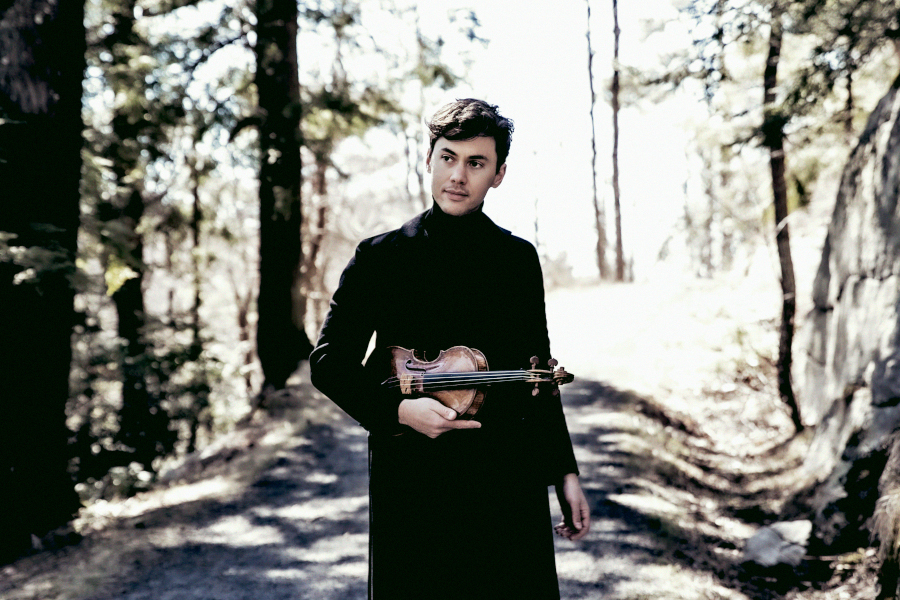
The NFM Wrocław Philharmonic concert, conducted by Thierry Fischer, is entirely devoted to the music of Johannes Brahms, whose 130th death anniversary will be commemorated in 2027. The programme features two works written almost simultaneously – the sweeping Violin Concerto in D major and Symphony No. 2 in D major. The soloist will be American violinist Benjamin Beilman, hailed as one of the most distinguished artists of his generation.
The Violin Concerto in D major op. 77 was composed in 1878 for Brahms’s friend, the distinguished violinist Joseph Joachim. Its premiere took place a year later at the Gewandhaus in Leipzig, with Joachim as soloist and Brahms conducting the orchestra. The work was enthusiastically received by the audience, although critics were not unanimous. One of them described the concerto as written “against the violin”, even Henryk Wieniawski deemed it unplayable, and Pablo de Sarasate refused to play it, claiming he had no intention of standing idly on stage during the Adagio, where the composer had entrusted the most beautiful melody to the oboe. History has vindicated these opinions. Today, Brahms’s Violin Concerto is one of the most important works in the repertoire for this instrument, valued not so much for its virtuosic effect as for its symphonic sweep, rich texture, and balance between solo and orchestra. In the slow movement, the lyrical oboe solo is particularly noteworthy, briefly becoming the protagonist of the narrative, while the finale, inspired by Hungarian music, enchants with energy, imagination, and exuberance.
Symphony No. 2 in D major was written in the summer of 1877 during Brahms’s stay in picturesque Carinthia. The composer completed it in just a few months, a stark contrast to the years of work on the First Symphony. After its premiere, commentators quickly began comparing the new work to Beethoven’s Pastoral. Indeed, the Second is among Brahms’s most serene works, though beneath this impression there are also moments of contemplation and anxiety. The work’s third movement is particularly charming – a subtle stylisation of the minuet, one of the most popular dances of the Classical era. The finale, meanwhile, brings music overflowing with brilliance and energy. The mounting tension leads to a triumphant climax, in which the brass instruments sound particularly impressive. Thanks to its combination of lyricism and optimistic expression, the Second Symphony remains one of Brahms’s most frequently performed compositions.