
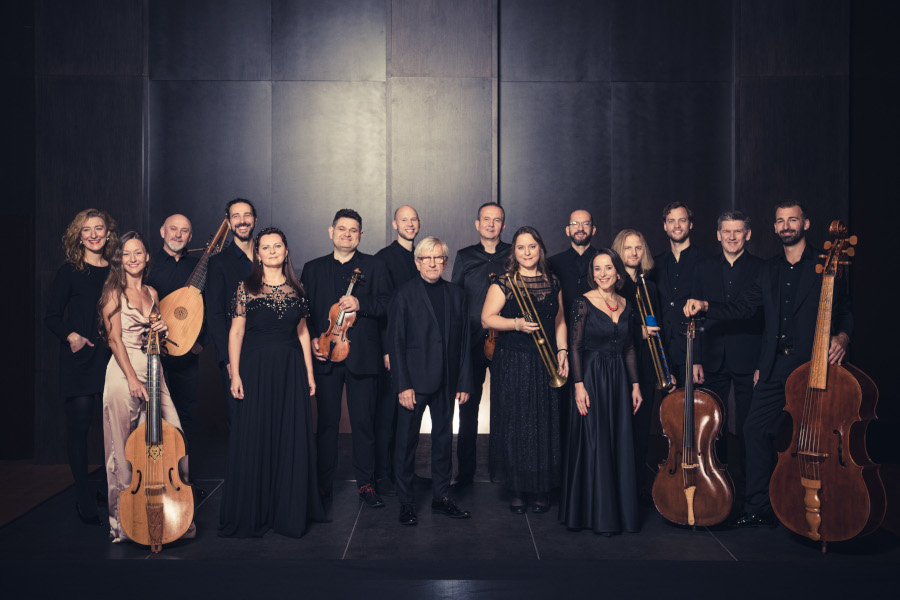
As early as the 1st century AD, Roman envoys searching for amber, reaching the Baltic Sea, proved that the Empire’s borders were not impenetrable, and that Central Europe was not isolated from the Roman influence. Over time, the former ancient trade routes became avenues of profound cultural exchange, the lasting fruits of which are evident in Baroque music. Wrocław Baroque Ensemble, under the direction of Maestro Andrzej Kosendiak, will once again follow the Amber Road, presenting the shared heritage connecting the cities of the Italian Peninsula with the centres along the ancient trade route leading to the delta of the Vistula River.
The musical journey will begin in Naples with Francesco Provenzale’s polychoral Pange lingua. The figure symbolising the other end of the route will be Kaspar Förster Jr – a composer born in Gdańsk and educated in Rome, who played a role in the dissemination of Italian style in countries north of the Alps, including Poland and the Kingdom of Denmark. The works of Tarquinio Merula – an organist from Lombardy working in Warsaw – and the masterful communiones by Mikołaj Zieleński, a composer associated with the court of the Primate of Poland in Łowicz, published in Venice, will also serve as a testament to the Italo-Polish exchange.
The Danube basin was an important region on the ancient merchant route. The concert programme will feature a work by the Hungarian aristocrat Pál Esterházy and a composition by the renowned violin innovator Heinrich Ignaz von Biber. The evening’s repertoire will also include Samuel Capricornus’s Magnificat and a sonata by trumpeter Pavel Josef Vejvanovský. The journey will culminate in the work of Józef Zeidler from the Wielkopolska region. His mass, combining the Baroque with the new style of Haydn and Mozart, is evidence that Viennese stylistic innovations also reached Poland via paths travelled centuries earlier by Roman traders of Baltic “gold”.