
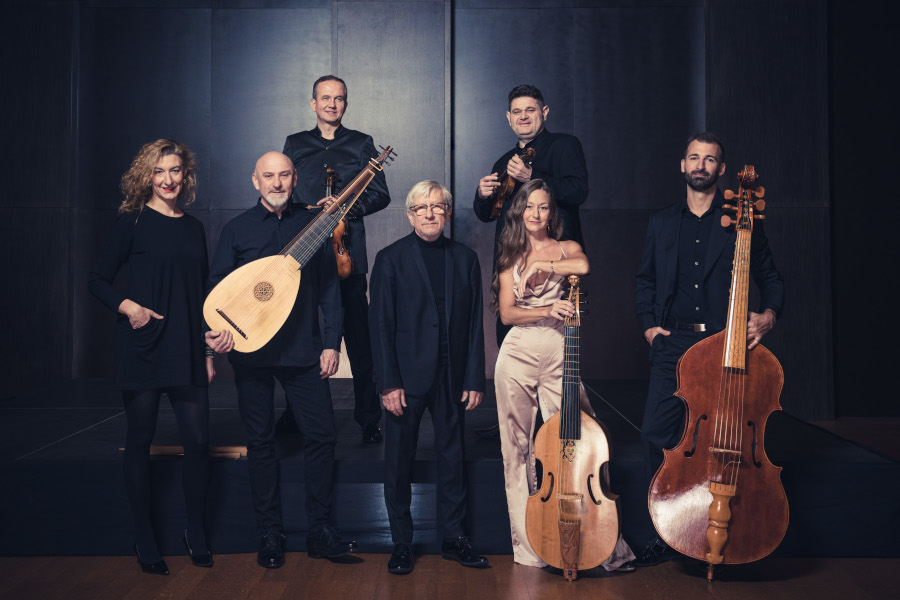
The Christmas season is an excellent reason to listen to Johann Sebastian Bach’s cantatas intended for this time of the year. The Lutheran liturgy, which, after the December holiday, does not dwell on the mystery of the Incarnation for long, allowed the German artist to explore a vast wealth of theological themes. At the same time, these works also contain genuine emotions at the sight of the manger and the newborn Saviour lying within. At the NFM, they will be performed by Wrocław Baroque Ensemble, conducted by Maestro Andrzej Kosendiak.
Intended for the Sunday after December 25th, the cantata Das neugeborne Kindelein from 1724 combines the celebration of the Nativity of the Lord with the celebration of the New Year. The work opens with a gentle choral fantasy in the form of a lullaby. The tranquility is broken by a dramatic bass aria calling on sinners to abandon their wrong path. But the soprano, accompanied by three flutes, recalls the New Covenant between God and humanity and thus introduces an optimistic mood. The joyful atmosphere persists throughout the composition. “Today is the time for singing,” announces the choir. The older Tritt auf die Glaubensbahn is also scheduled for the same day. It was composed in Weimar for the Schlosskirche. Bach’s cantatas from this period are exceptionally intimate, and this one is no exception. The Eisenach master, a rarity in his works of this type, begins with a fugue. In subsequent recitatives and arias, Salomon Franck’s libretto focuses on the Gospel comparison of Jesus Christ to a cornerstone, as well as the need for human conversion. In the finale, a surprisingly dance-like dialogue between the Son of God and the Soul, the adoption of this attitude – the ultimate unity and order – is symbolised by a part played simultaneously (in unison) by all the melodic instruments.
Sie werden aus Saba alle kommen, which begins the second part of the concert, is a piece for the Epiphany. It presents the arrival of the Magi to the Holy Family as a fulfillment of the prophecy recorded by Isaiah and calls upon us to dedicate our hearts to God, like gold, frankincense, and myrrh. Following the Gospel account of the figures visiting the Child – “wise men from the East” – the composer uses musical means to suggest their cultural differences by incorporating recorders, oboes da caccia, and horns – instruments that evoke Asian associations in Baroque music. Here, they are used to maximise the richness of sound. The attribution of the authorship of the last cantata in the programme to Johann Sebastian Bach is highly questionable. The oldest surviving manuscript copy of the Christmas cantata Uns ist ein Kind Geboren was made in 1755 by the artist’s student, Christian Friedrich Penzel. He believed that the composition was written by his teacher. However, this attribution was rejected by experts in the 20th century. There is also no consensus regarding the work’s actual composer. Perhaps it was Johann Kuhnau, Bach’s predecessor as cantor of St Thomas Church in Leipzig. The ambiguities do not detract from the cantata itself. The music, set to text based on a libretto by Erdmann Neumeister, captivates with its inventive instrumentation. In three arias for bass, tenor, and alto, the soloists are accompanied, respectively, first by violins, then by oboes, and finally by recorders.