
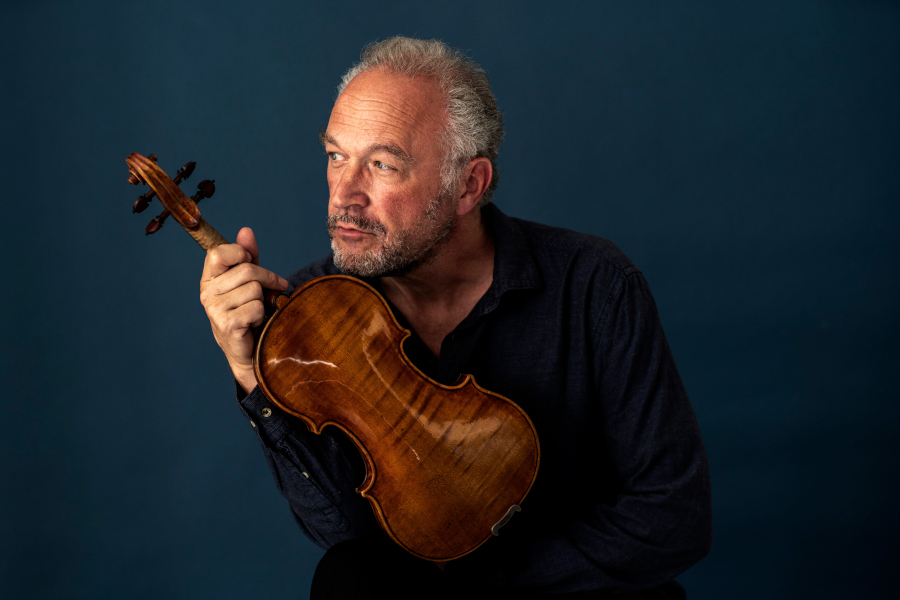
Kolja Blacher is a phenomenal violinist and conductor, a former close collaborator with Claudio Abbado. He returns to Wrocław to present works by Joseph Haydn, Maurice Ravel, and Noam Sheriff. The latter was a composer who was once a student of Boris Blacher – Kolja’s father. The artist will not only perform solo parts this evening but also direct the NFM Leopoldinum Chamber Orchestra. The entire programme will be a testament to the musicians’ extraordinary versatility.
After graduating, Sheriff, who passed away in 2018, embarked on a successful career as a composer, conductor, and teacher. As a composer, he became renowned for combining Eastern and Western traditions and using atonal sonic language. This description perfectly fits the 1983 composition Prayers, rooted in Jewish traditions, which will open the evening. Joseph Haydn’s Violin Concerto in C major, composed in 1765, will then be performed. It was written with the Italian virtuoso Luigi Tomasini – concertmaster of the court orchestra of Prince Esterházy – in mind. The work is still hardly classical in style – it is distinguished by its use of basso continuo, the absence of wind instruments, and contrasting themes. Each of the three movements is in the form of a sonata allegro. The first captivates with its joyful, march-like character and the bright register of the violin. In the middle movement, the soloist delights with a melodious, almost operatic line against a pizzicato accompaniment. The whole culminates in a dance-like, spectacular finale, full of Haydn’s famous, infectious cheerfulness.
Haydn is sometimes called the “father of the string quartet”. Maurice Ravel employed this genre only once – in 1903. The then twenty-eight-year-old composer was inspired – as he later admitted – by a similar work written exactly a decade earlier by Claude Debussy. When writing his String Quartet in F major he was still an undergraduate and hoped it would win him the prestigious Prix de Rome. He also submitted its first movement to the composition competition at the Paris Conservatoire. However, the work was rejected by the bodies deciding on the awarding of both distinctions, and as a result, Ravel left the academy. According to an often-cited anecdote, Debussy became familiar with the work and later wrote to his younger colleague: “I adjure you, in the name of the gods of music and my own, do not touch a single note you have written in your Quartet.” The Quartet has gone down in history surrounded by a halo of admiration. We will hear it arranged for string orchestra.