
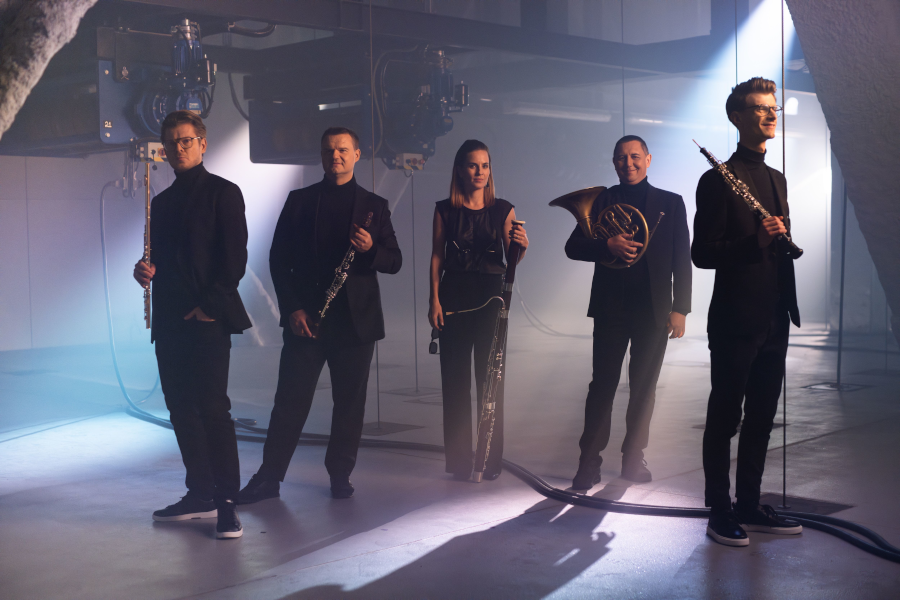
Between danse macabre and choreomania, vitalist folklore and churlish decadence – the LutosAir Quintet invites you to a concert featuring a diverse range of dance music. You will embark on a journey across Europe. Even skeptics will be able to see that rhythmic movement is one of the fundamental human qualities.
In the Baroque period, it was a fundamental component of suites, but in the Classical era, it lost its privileged position among musical genres and became highly conventionalised. Dance subsequently returned to art music as an element of folklore, which was being bridled by Romanticism. Examples of two traditions that flourished in the 19th century include a stylised minuet from Brahms’s serenade, which evokes the style of the 18th century, and Edvard Grieg’s later Norwegian Dances, which create a playful image of the continent’s northern periphery. The 19th-century corset imposed on folk music was shattered in 1913 by Igor Stravinsky’s scandalous work, The Rite of Spring, in which folklore appeared as a wild, destructive, and untamed force. The performance of the orchestral music for this ballet by a wind quintet will be an unprecedented event for fans of Le Sacre du printemps!
Henri Tomasi’s colourful, modernist suite combines fantastic dances of various natures within a genre revitalised by Neoclassicism: rural, sacred, and martial. The ritual dimension of movement was also highlighted by Manuel de Falla, who included the temperamental Danza ritual del fuego in his ballet El amor brujo. We will hear Dmitri Shostakovich’s Waltz No. 2, famous as a symbol of ghastly doom in Stanley Kubrick’s film Eyes Wide Shut – interestingly, the piece originally appeared in a Soviet film about agricultural pioneers in the steppes of Kazakhstan, where it serves as a ceremonial piece and has a rather optimistic tone. The programme will conclude with the incredibly picturesque and rhythmically engaging landscapes of Transylvania, evoked by Béla Bartók's Six Romanian Dances, originally composed for piano in 1915.