
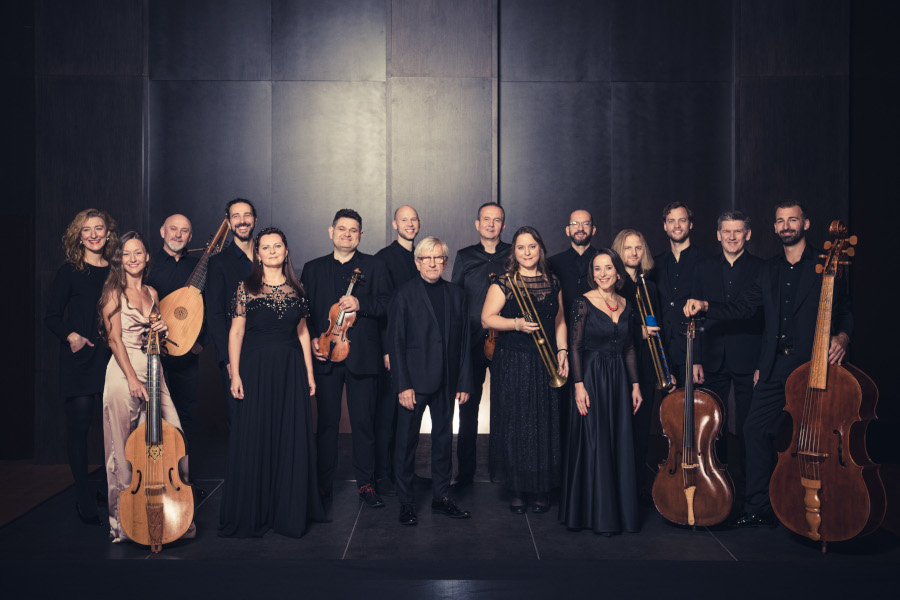
Easter is a time when the world ceases to be ordinary. Wrocław Baroque Ensemble, under the direction of Maestro Andrzej Kosendiak, will usher us into this exceptional period. Specialising in historical performance, the ensemble has prepared a programme of Polish and Italian sacred music, corresponding to the events commemorated in the rites of Holy Thursday, Good Friday, and the Easter Vigil.
The concert will open with Mikołaj Zieleński’s motet In monte oliveti, intended for Holy Thursday. The composer’s legacy, which has survived to this day, is contained in the two-part collection Offertoria et Communiones Totius Anni, published in Venice in 1611. The text evokes Jesus’ prayer in the Garden of Olives and his words to St. Peter: “The spirit is willing, but the flesh is weak.” This is a poignant image of the Saviour fearing the imminent suffering and death. A traditional sequence depicting Mary at the foot of the cross will set the mood for Good Friday. The Stabat Mater, with its thirteenth-century roots, has become the foundation for many superb musical settings – from the Baroque works of Charpentier, Scarlatti, and Pergolesi to the twentieth-century works of Karol Szymanowski. Artists from Wrocław Baroque Ensemble will perform Stabat Mater by Antonio Maria Bononcini. Born in Modena, Bononcini’s activities took him to Rome, Vienna, and, towards the end of his life, once again in the Po Valley. Despite its Italian character, his Stabat Mater is restrained in expression and full of inner focus.
A Polish composer active at that time was Grzegorz Gerwazy Gorczycki – a clergyman from Upper Silesia and Kapellmeister of Wawel Cathedral. It is therefore not surprising that he focused on religious works. This time, we will hear the four-part Missa Paschalis, and specifically its fragment intended for Easter. The author combines European influences with Polish traditions, manifested in the use of melodies from popular hymns: Wesoły nam dzień dziś nastał and Chrystus Pan zmartwychwstał. The concert will conclude with Mikołaj Zieleński’s solemn, two-choir motet Salve festa Dies from Offertoria Totius Anni, in which a joyful Alleluia heralds the most important holiday of the liturgical year.