
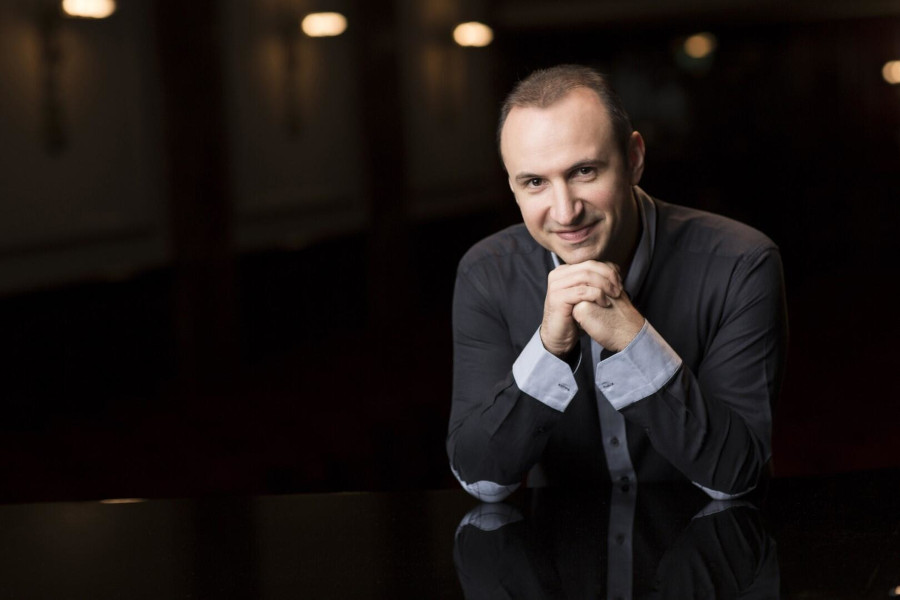
Together with Belgium’s L’Orchestre Philharmonique Royal de Liège, we will embark on a journey through the 19th-century French repertoire. Masterpieces by Gabriel Fauré, Camille Saint-Saëns, and Hector Berlioz will be played under the baton of the orchestra’s Music Director Lionel Bringuier, with North Macedonian pianist Simon Trpčeski as the soloist; the NFM Choir will also perform.
The evening will open with a composition by Gabriel Fauré from 1887: the Pavane in F-sharp minor op. 50. This piece references an old Italian dance, evocative of an elegant procession. Its revival in France during the second half of the 19th century emerged alongside a growing sense of musical patriotism following the defeat in the war against Prussia. The lyrics, sung by the choir, touch upon the grotesque nature of romantic entanglements between men and women. Dating from 1868, the time when the Second French Empire saw its twilight, is the Piano Concerto No. 2 in G minor op. 22. It is by far the most popular of the five piano concertos penned by Camille Saint-Saëns, and it clearly reveals the composer’s own formidable skill as a pianist. Notably, the work lacks distinct “national” stylistic traits, even though Saint-Saëns himself was the founder of the Société Nationale de Musique during the Third Republic.
After the intermission, we will hear the most famous work by a quintessentially Romantic composer: the Symphonie fantastique op. 14. Hector Berlioz’s work was composed when Saint-Saëns was five years old, and before Fauré had even been born. It stands as a pioneering example of programme music, one that is, moreover, autobiographical in nature. Within the score, the composer introduced an obsessively recurring theme, an idée fixe, presenting it in various guises, ranging from the pastoral to the macabre. It represents the image of a beloved woman, an image from which the artist could not break free. Leonard Bernstein famously described the piece as “the first psychedelic symphony in the history of music.” This performance features an orchestra established in 1960, representing Wallonia, the Francophone region of Belgium, which positions itself at the intersection of French and German musical traditions. Lionel Bringuier has led the orchestra since September 2025, drawing upon the experience he gained working with orchestras in Paris, Los Angeles, Valladolid, Zurich, and his native Nice.