
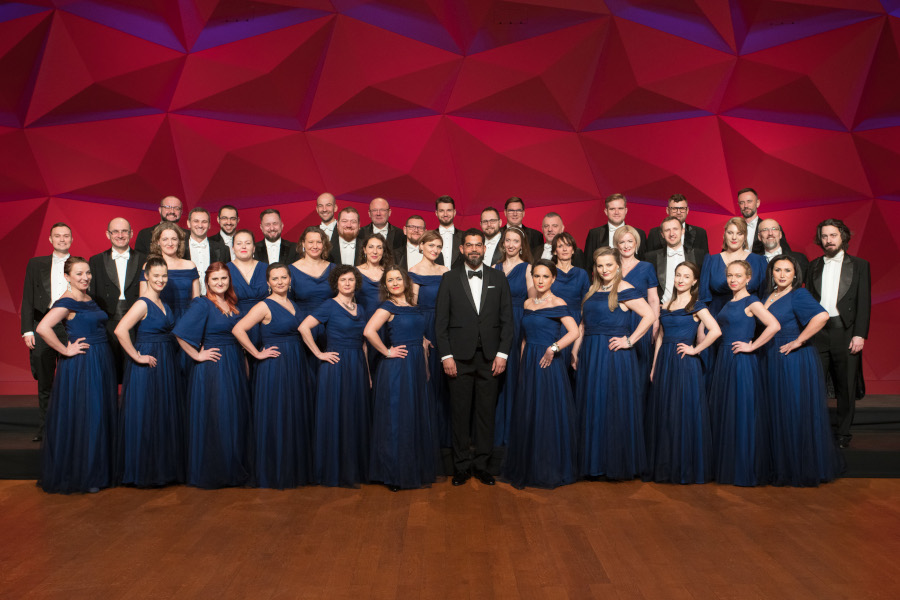
Motets – polyphonic vocal composition traditionally lacking independent instrumental parts – make up only a small portion of Johann Sebastian Bach’s rich output. The NFM Choir, conducted by Lionel Sow, will present six works in this genre created by this Baroque composer. The artist wrote them for special occasions, often taking advantage of the fact that in Leipzig he had more performers at his disposal for such events than during ordinary church services. Following the Baroque practice, the singers at the NFM will be accompanied by a small ensemble comprising Bartosz Kokosza, Janusz Musiał, and Marta Niedźwiecka.
The first of the motets, the joyful Singet dem Herrn ein neues Lied for double choir, dates back to 1726 and 1727. It sets words from Psalms 149 and 150 together with an excerpt from a Lutheran hymn by Johann Gramann. The exact circumstances of the work’s composition remain unknown. It inspired the enthusiasm of Wolfgang Amadeus Mozart himself when he heard it in Leipzig in 1789. By contrast, the next composition, Der Geist hilft unser Schwachheit auf from 1729, is known to have been written for the funeral of Johann Heinrich Ernesti – a philosopher, Lutheran theologian, poet, and rector of St Thomas School, with which Bach was associated for many years. Written for two choirs, the piece uses an excerpt from St Paul’s Epistle to the Romans (“The Spirit helps us in our weakness…”). Ernesti himself chose this text before his death, and must therefore have wished his commemoration to express an optimism grounded in faith. Bach’s serene music, at times taking on an almost dance-like character, fulfilled that wish perfectly. The German composer also based his most elaborate motet, Jesu, meine Freude, on the writings of St Paul of Tarsus, supplemented by a hymn by Johann Franck. It is a masterful, multi-movement work, featuring a changing arrangement of voices. According to the most widely accepted hypothesis, it was commissioned for the funeral of Johanna Maria Kees, wife of Leipzig’s postmaster, and was first performed on July 18, 1723 at St Nicholas Church in Leipzig.
Written for double choir, the motet Fürchte dich nicht, was probably composed for a memorial service held in Leipzig on February 4, 1726, although it may be older and could have been written by Bach during his time in Weimar. Employing a variety of textures, Bach combined a text from the Book of Isaiah with excerpts from a hymn by the Lutheran poet Paul Gerhardt, making the consoling biblical words “Do not be afraid” a recurring motto. The Baroque genius took the two stanzas by Paul Thymich used in Komm, Jesu, komm from the 1697 Wagnersches Gesangbuch (one of Bach’s predecessors as cantor of St Thomas Church, Johann Schelle, had previously drawn on the same passage from this hymnal). The structure of the composition is based on two contrasting sections: the first is treated with extraordinary expressiveness, while the second is considerably more restrained. Psalms will return at the conclusion of the programme in the cheerful and energetic Lobet den Herrn, alle Heiden. Here we will hear Psalm 117, characterized by a spirit of praise, the shortest piece in the entire Book of Psalms. The way the biblical verses are treated in their German translation has led scholars to suggest that the original lyrics in the composition may have been in Latin. Although Bach’s authorship is sometimes questioned, in the absence of conclusive evidence the work continues to be performed as part of the oeuvre of the Eisenach-born master.