
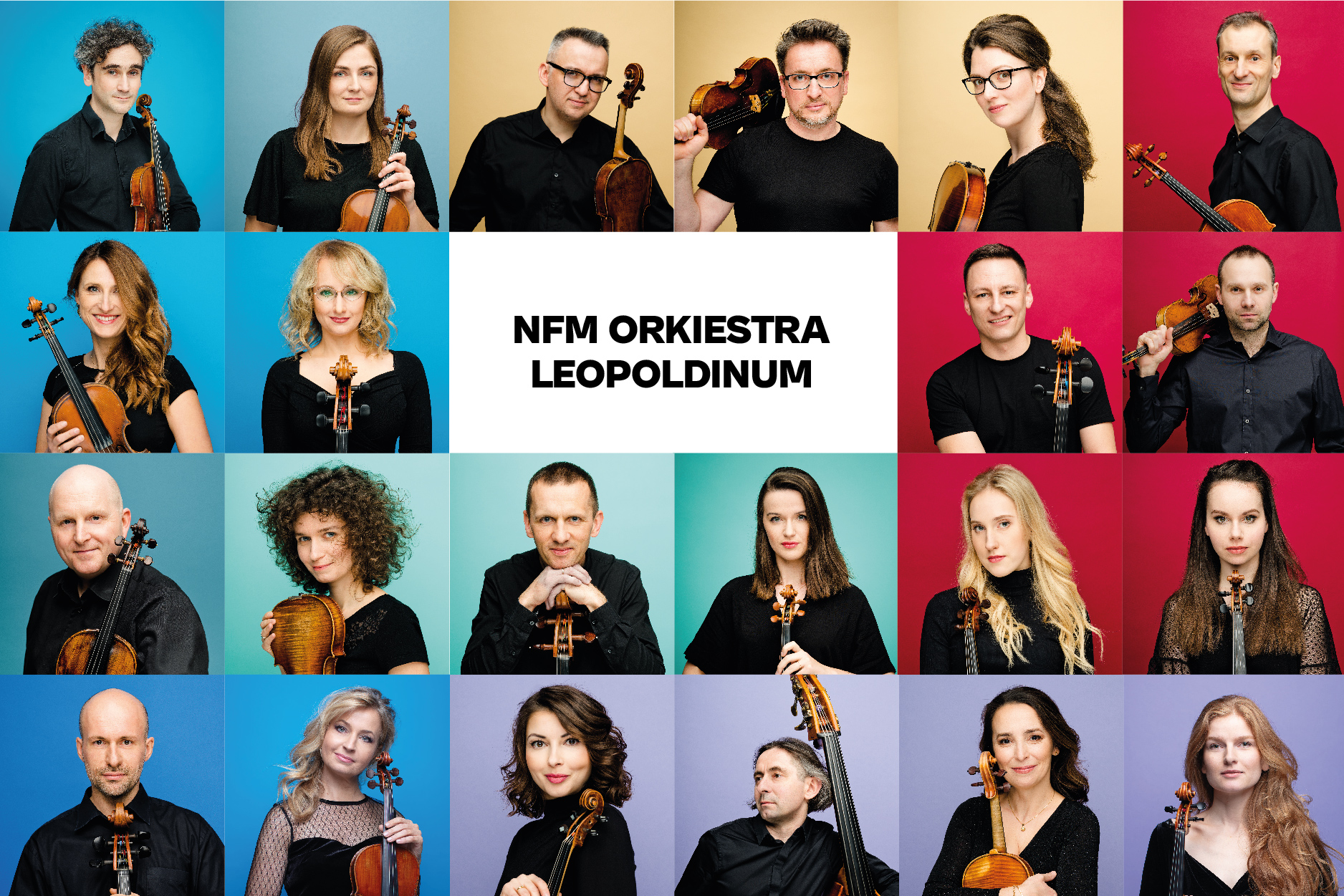
The NFM Leopoldinum Chamber Orchestra will present a rich cross-section of chamber music. The programme will feature works by Classical and Romantic masters: Wolfgang Amadeus Mozart and Felix Mendelssohn Bartholdy, the artists will also present music by a nearly forgotten Polish composer. It will also include contemporary music inspired by both virtual reality and early art. The instrumentalists will be joined by acclaimed pianist Anna Rutkowska-Schock, affiliated with the Karol Lipiński Academy of Music.
In 1785, the publisher Franz Anton Hoffmeister commissioned three piano quartets from Mozart. After receiving the first, however, he withdrew from the agreement, considering the work too difficult for his customers. Nevertheless, nine months later Mozart wrote another piece – the Piano Quartet in E-flat major, KV 493. The work was issued by Artaria publishing house, whose proprietors presumably hoped that Hoffmeister had misjudged the results of the Austrian composer’s efforts and that they could turn the collaboration into a profitable venture. They must have been bitterly disappointed when, sometime later, exactly the same opinion as that expressed by the ill-fated commissioner appeared in a newspaper. This does nothing, however, to diminish the beauty of this composition that delights with its subtle expressiveness and genuinely virtuosic piano part. Said piece will be followed by music from a figure whose stature has received far less recognition. For many years, Witold Maliszewski was remembered primarily as Witold Lutosławski’s teacher. Today, however, his own output is also attracting interest. Born in Podole, he later studied in St Petersburg with two leading figures of Russian music: Alexander Glazunov and Nikolai Rimsky-Korsakov. The realities of life in the East following the outbreak of the Bolshevik Revolution prompted him to move to the newly reborn Polish Republic in 1918. His four-movement String Quintet, Op. 3, was published in 1904 by Mitrofan Belyayev’s Leipzig publishing house. At that time, Maliszewski remained strongly influenced by his teachers; it was only later that he turned towards Polish folk music.
The second half of the concert takes us into an entirely different realm of inspiration. In early modern Europe, the term “Grand Tour” referred to a journey undertaken by young aristocrats and intellectuals to broaden their horizons. In the twentieth century, automotive marketing specialists adopted this culturally established concept to describe a class of expensive, comfortable cars offering sports-car performance. Since many of these cars were built in Italy, the term gran turismo became widespread. Years later, Japanese developers used this very expression as the title of a motor-racing simulation game – a commercial success that launched an entire series of console releases. One instalment fascinated the American composer Andrew Norman, who associated it with the paintings of the Italian Futurists and the virtuosity of Baroque music. Employing historical techniques, he created an undeniably contemporary work characterised by rapid pace. The concert will conclude with the four-movement Piano Sextet. Felix Mendelssohn Bartholdy, then only fifteen years old, composed it in just fourteen days. By that time, Goethe had already proclaimed him the new Mozart. Mendelssohn never published the composition during his lifetime; it appeared posthumously, hence its high catalogue number. Its unusual instrumentation: piano, violin, two violas, cello and double bass, suggests that the work was intended for a particular ensemble of performers. This makes the skillfulness of the young master all the more remarkable. The brilliant, almost showpiece-like piano part – especially in the finale – reflects Mendelssohn’s fascination with Carl Maria von Weber’s Konzertstück. It makes the sextet sound almost like a piano concerto.