
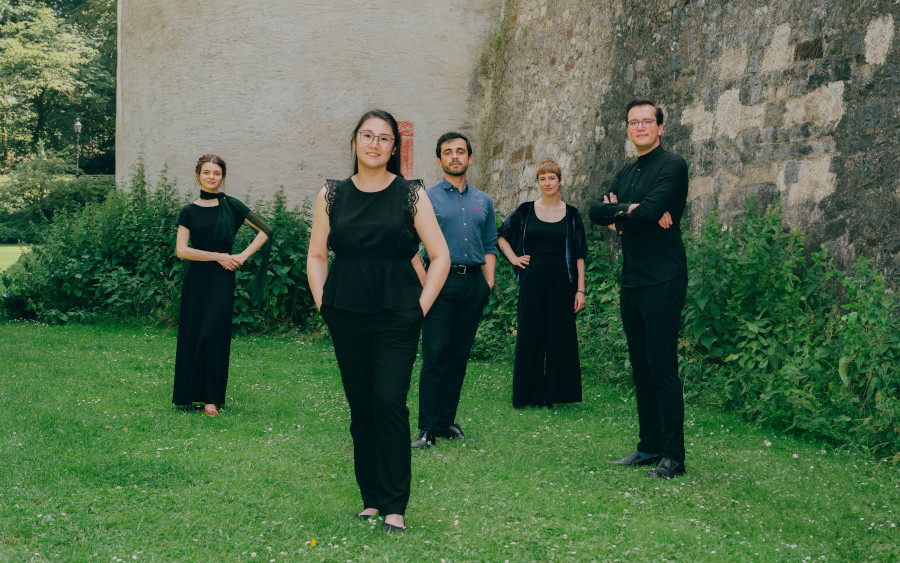
At the conclusion of this year’s Forum Musicum, Ensemble Pampinea will present works showcasing the ars subtilior style. This remarkable trend, which emerged in European music in the late 14th century, is the culmination of a broader aesthetic movement known as ars nova. The birth of compositions that were incredibly complex in structure and challenging to perform, was made possible by advances in musical notation and the composers’ particular appreciation for refined beauty.
Ensemble Pampinea is a versatile group performing medieval and Renaissance music. Hailing from various countries, the artists specialise in presenting early works within a broad cultural context. They are proficient in using various instruments, allowing them to recreate sounds from centuries ago, and they also use the power of the human voice. Graduates of the Schola Cantorum Basiliensis, they combine extensive research – gaining profound insights into the art of the past – with a commitment to building a strong connection with their audiences. This approach makes them delight both connoisseurs and listeners seeking entirely new experiences. The musicians boast, among other things, winning first prize at the London Early Music Young Ensemble Competition in 2022. They currently perform not only throughout Europe but also beyond.
The concert programme, held in the historic Old Refectory, dating from 1724, at the Dominican Monastery in Wrocław, is divided into several sections. Their titles will guide the listeners to those aspects of the works that are worth paying attention to at a given moment. In addition to anonymous works, the ensemble will also present compositions by figures such as Matheus de Perusio, Solage, Jacob Vaillant, Johannes Symonis Hasprois, Petrus Fabri, and Antonello da Caserta. These pieces are considered elite works, characterised by exceptionally intricate rhythms, melodies, and harmonies. It is safe to say that among them we will find the most eccentric works of the late Middle Ages, such as Vaillant’s Par maintes foys imitating birdsong or Solage’s bizarre, chromatic Fumeux fume, sometimes interpreted as a description of experiments with drugs.