
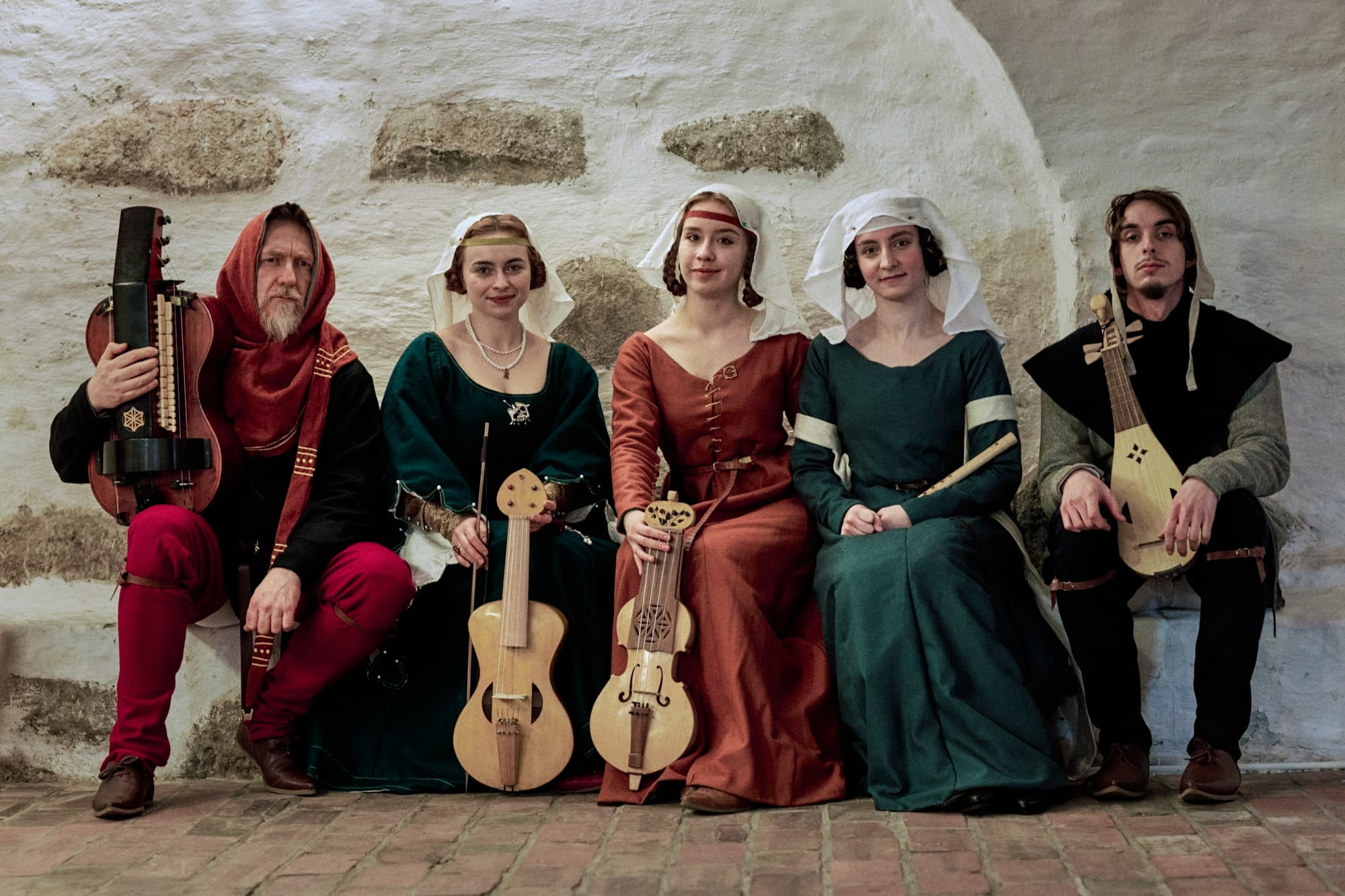
The Medievals is a Polish ensemble interpreting the music of The Middle Ages. Their energetic style is reflected in last year’s debut album, Douce musique; it features ten compositions, recorded with true rock verve, presenting a comprehensive overview of the art of the era of castles and knights. The artists will be performing at the festival as recent winners of the special award at the 46th Schola Cantorum International Festival of Early Music Ensembles.
The group brings together musicians united by a passion for reenacting medieval culture with professional approach. Thanks to their specialised training and years of involvement in historical reconstruction, the group faithfully restores the sounds of the past. Working with a repertoire spanning several centuries, its members use only exact replicas of period instruments, such as the knee fiddle, gittern, hurdy-gurdy, frame drum, and the medieval recorder. The Medievals’ dedication is highlighted by hand-sewn costumes modelled on those from the 15th century.
Among the anonymous pieces in the programme, which combines folk and high art traditions, are the Sephardic Durme, Durme and the Old English Miri it is while sumer ilast. We will also hear the still-popular nursery rhyme Ai vis lo lop. The concert will feature masterful virelais by Guillaume de Machaut – a musical luminary of 14th-century France. The famous Cantigas de Santa Maria will be performed too, coming from the 13th-century collection of hymns written in Galician and composed at the court of Alfonso X, King of Castile and León. The closing piece will be Kalenda Maya, a serene song by the Provençal troubadour Raimbaut de Vaqueiras, dedicated to a lady named Beatrice. On Sunday noon, the sacred will merge with the profane, and courtly elegance with the atmosphere of the medieval narrow streets, evoking a colourful image of Europe in that era.