
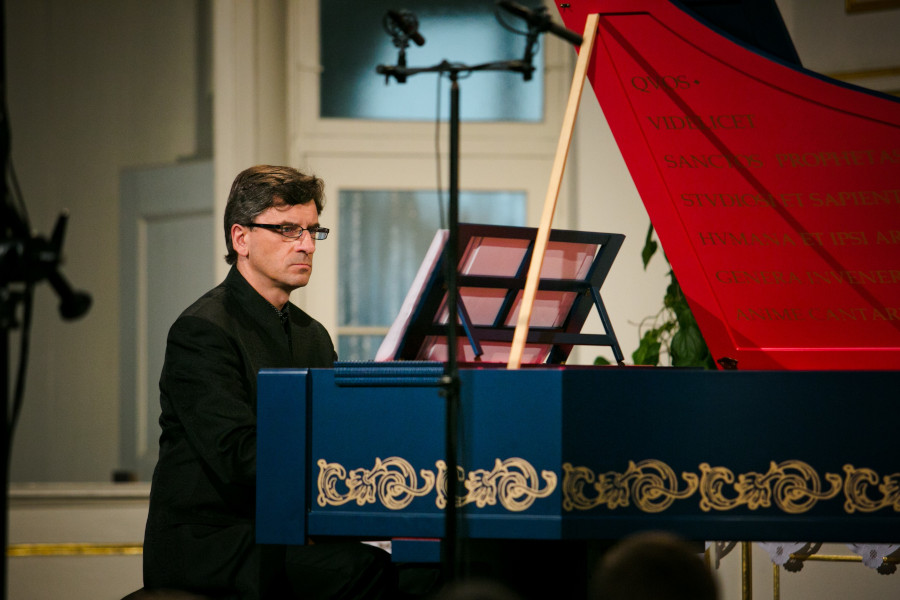
The inventor of the viola organista, a keyboard and string instrument in one, was Leonardo da Vinci. His sketches, recorded in his private notes from 1489–1492, known as the Codice Atlantico, show the evolution of the concept from the hurdy-gurdy, already known in the Middle Ages, to a structure that, according to the inventor’s plans, was intended to resemble a harpsichord. The author of the Portrait of Cecilia Gallerani, himself a musician, desired to create a perfect instrument: one that would combine the possibilities of performing multi-part compositions on the keyboard with the continuous, expressive sound of the viola. During the Forum Musicum, Sławomir Zubrzycki, who constructed his own version a dozen years ago, will demonstrate the possibilities of this forgotten instrument.
In creating the viola organista, Zubrzycki drew on the same principle of construction as that developed by Leonardo, used at the turn of 17th century – a period of great creativity among instrument builders. The first such device – called the Geigenwerk – was realised in Nuremberg in 1575 by Hans Heiden. Although he claimed sole credit for the invention, his improved version from 1600 was a near-identical replication of the mechanism developed over a century earlier by da Vinci. Heiden’s instrument, later described in Michael Praetorius’s famous Syntagma Musicum, inspired subsequent makers across Europe. Over the centuries, the idea resurfaced under various names: the Lyrichord, Bogenklavier, and the clavioline. The principle of sound production was always similar – pressing a key brought the string close to rotating wheels or a moving belt, acting like a viola bow.
Sławomir Zubrzycki is a graduate of the Krzysztof Penderecki Academy of Music in Kraków and has been involved in popularising the viola organista since 2014. He emphasises that “reconstructing the instrument and reconstructing the repertoire are two parallel processes”. The festival concert will feature a diverse programme, spanning Renaissance and Baroque periods. We will hear works by the masters of the Franco-Flemish school. During these composers’ lifetimes, the line between instrumental and vocal music was fluid. This is evidenced by the performance of two versions of the song Susanne un jour. Renaissance dances will be featured, including those from Jan of Lublin’s tablature. We will also hear works by the French composer Marin Marais – the greatest viola da gamba virtuoso at the court of Le Roi Soleil.