
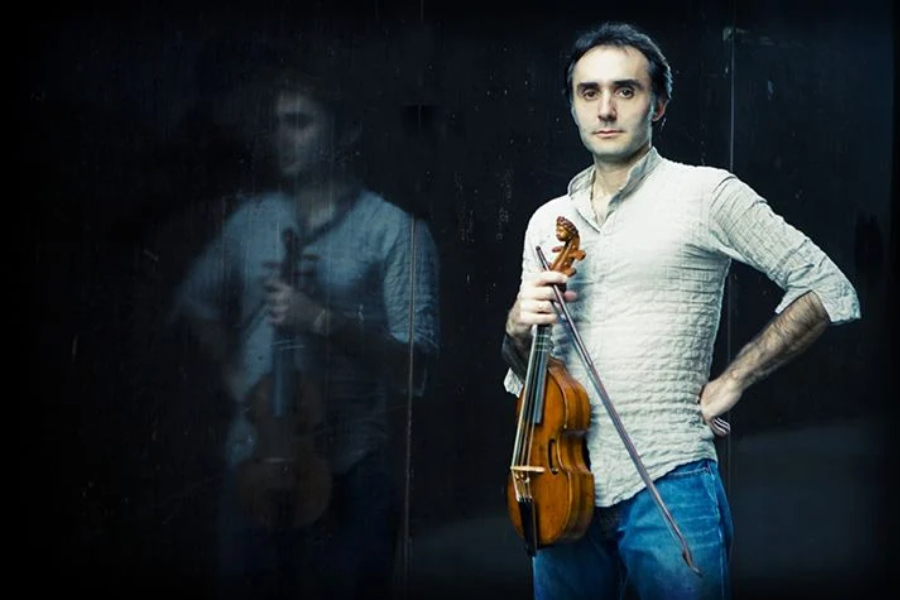
Hailing from Milan, the viola da gamba virtuoso Vittorio Ghielmi will once again conduct Wrocław Baroque Orchestra. Georg Philipp Telemann will prevail in their concert programme. Ghielmi and WBO will be joined by soloists: flautist Dorothee Oberlinger, dulcimer player Marcel Comendant, and violinist Stanislav Palúch. In the second part of the evening, these musicians will break up the sound of a seventeenth-century ensemble with folk improvisations. We will thus examine the face of Europe from two different perspectives.
Georg Philipp Telemann left behind approximately one hundred and twenty-five orchestral suites (known as overtures), an equal number of concertos, and a large number of other instrumental works. He rarely published his pieces intended for large ensembles. This meant they had an incidental role and a limited scope. Illustrative titles – for example, those related to his travels – were often given to such compositions. We will hear them in the first part of the concert, in which the musicians will remain faithful to the conventions of historical performance. Telemann travelled in many European countries. The first overture will feature his musical portraits of Turks, Swiss, Muscovites, and Portuguese. The title of the Alster suite comes from the river at whose mouth Hamburg was founded – it features a captivating concert of local crows and frogs. The programme will also include Irish, Neapolitan, French, Italian (the aria features a recorder), and finally Polish motifs.
The music of our country enjoyed Telemann’s considerable interest. He noted it down, captivated by its “barbaric beauty” (by which he also meant pieces inspired by Moravia, represented in the programme by Hanasky). Therefore, there will be dances from his manuscript, discovered in Rostock in the 1970s. In addition, the anonymous Saltus polonicuswill be performed, from a collection of similar compositions discovered in 1956 in Uhrovec (now Slovakia). All of this will be enhanced by the improvisational skills of Marcel Comendant and Stanislav Palúch, who will draw on the heritage of the former Polish and Hungarian territories. This part of the evening, rich in concertante pieces, will thus become a space for musical dialogue with the past.