
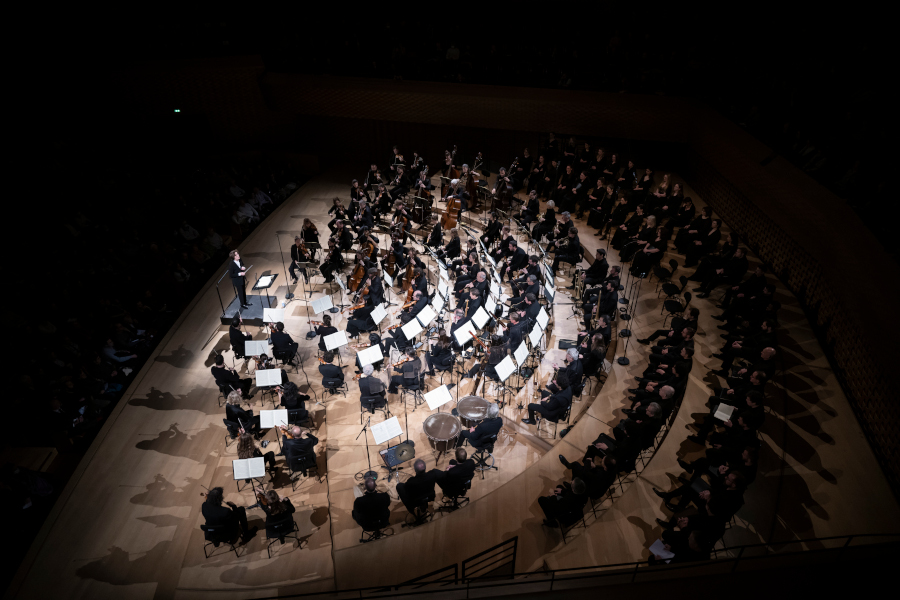
The bicentennial of Ludwig van Beethoven’s death in 2027 will be an excellent opportunity to honour the Bonn master and revive his work even more frequently. France’s Insula Orchestra, founded in 2012 by the esteemed conductor Laurence Equilbey, will play two of the composer’s groundbreaking works on period instruments under her baton. The Symphony No. 6 “Pastoral”," will be performed, expressing a love of nature, and the second part of the concert will feature the canonic Piano Concerto No. 5 “Emperor”. Pianist David Fray will perform the solo part.
Ludwig van Beethoven completed the Sixth, his only five-movement symphony, in 1808. According to the artist, it was intended to reflect the feelings associated with being in the bosom of nature. The piece abounds with effects illustrating the natural world: the rhythmic strings convey the murmur of a stream, the wind instruments imitate birdsong, and the percussion beats and tremolo effects depict storms. To ensure precise expression, the composer gave the individual sections literary titles (from The Awakening of Serene Feelings Upon Arrival in the Countryside to Joyful and Grateful Feelings After the Storm). Interestingly, Beethoven initially did not plan these, believing that listeners would guess the music’s meaning themselves. An anecdote about George Sand proves just how wrong he could have been – upon first listening to the work, the writer, unaware of the author’s intentions, interpreted the birdsong as the cry of a rebellious angel.
The Sixth Symphony was written during a period of Beethoven’s enormous creative outburst, lasting approximately six years. The culmination of this period was the Fifth Piano Concerto, “Emperor”. When preparing this composition, Beethoven already knew that it would be his first work in this genre, whose premiere would be held without him playing the piano. His hearing was increasingly failing, which prevented him from performing in public. Beethoven’s response to life’s upheavals, composed in Vienna under siege by Napoleon’s troops, the music radiates nobility and vigour. “I want to seize fate by the throat; it will not bend me completely,” the artist noted at the dawn of the 19th century. The compositions, which will be performed at the NFM by the Insula Orchestra, are proof that Beethoven succeeded in transforming suffering into a triumph of spirit and art.