
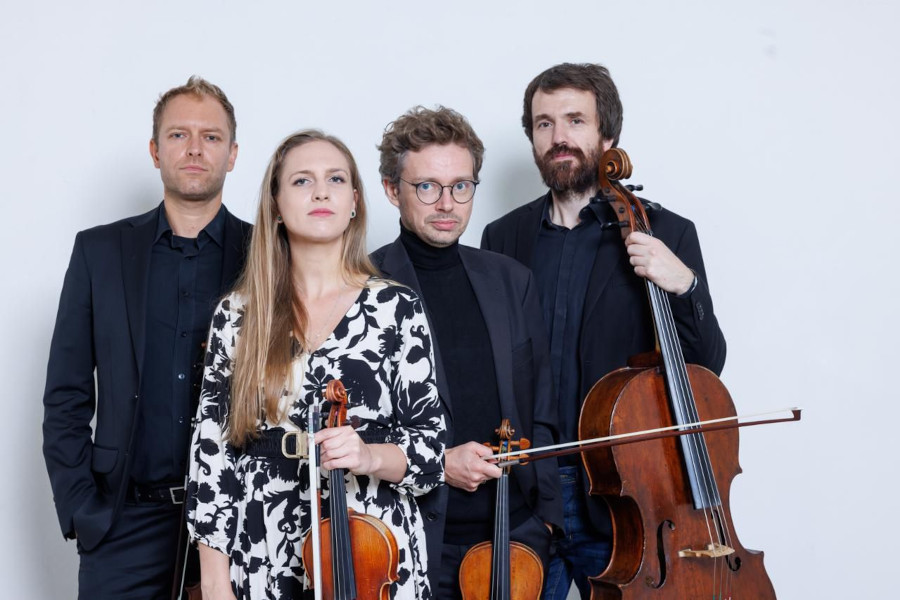
Alongside works by the Renaissance master Orlando di Lasso and the Baroque genius Johann Sebastian Bach, the Lutosławski Quartet will present a late composition by Ludwig van Beethoven. All these composers showed courage in formal solutions and willingness to push boundaries. This evening, we will also hear contemporary music. Its composers – Alfred Schnittke and Arvo Pärt – are renowned for their creative references to the art of bygone centuries.
The concert will begin with a recent composition. Da pacem Domine, from 2004, was commissioned by Spanish interpreter of early music Jordi Savall with Arvo Pärt. The piece combines the Gregorian antiphon with tintinnabuli and Renaissance techniques. The result is a moving prayer for peace, and its premiere was dedicated to the victims of the jihadist terrorist attacks in Madrid in 2004. The composer did not give any clear indication of the line-up, which led to numerous vocal and instrumental versions of the work. Next, we will listen to the work of a representative of the Franco-Flemish school, active in the second half of the 16th century. Orlando di Lasso was active in present-day Germany. However, he enjoyed international acclaim – his works were published by all the major music publishers of the time. Stabat Mater, from 1585, is originally an eight-part composition for two choirs. Although it does not belong to his radical works, scholars have demonstrated that the way in which the motifs are presented was ahead of its time and became widespread only in the Baroque period.
Alfred Schnittke went down in history as a representative of polystylism. In his work, he freely juggled allusions, quotations, and compositional techniques, often engaging in humorous, even overtly sarcastic, dialogue with the music of bygone eras. “One of my life’s goals was to bridge the gap between serious and light music, even if I had to break my neck in the process,” he wrote. The very beginning of String Quartet No. 3 demonstrates a broad stylistic range. In just a few bars, Schnittke quotes Lasso’s Stabat Mater, Beethoven’s Great Fugue, and the D-S-C-B(H) motif—a musical cryptogram used in Dmitri Shostakovich’s works. We will also hear Johann Sebastian Bach’s Fugue in B minor from The Well-Tempered Clavier, a comprehensive, two-part cycle of preludes and fugues. The entire piece was conceived as training material for young people. Each movement contains twenty-four pairs of pieces composed successively in major and minor keys, arranged in a chromatic sequence, from C major to B minor. The Fugue, performed by the Lutosławski Quartet, concludes the first volume of the collection. It is characterised by a mood of quiet, deep intellectual meditation.
The evening will be crowned with the Great Fugue. It was originally the final movement of Ludwig van Beethoven’s String Quartet in B flat major op. 130. The publisher asked the composer to write a new finale, fearing that the extremely difficult movement would discourage performers and audiences. Beethoven agreed, and the Great Fugue was published separately as op. 133. For many years, commentators spoke disdainfully of it, comparing it to a musical Tower of Babel and calling it “an unreadable, error-ridden nightmare”. It was only Igor Stravinsky who did justice to it, calling it “contemporary” a century after it was composed. Indeed, it has retained its astonishing freshness to this day.