
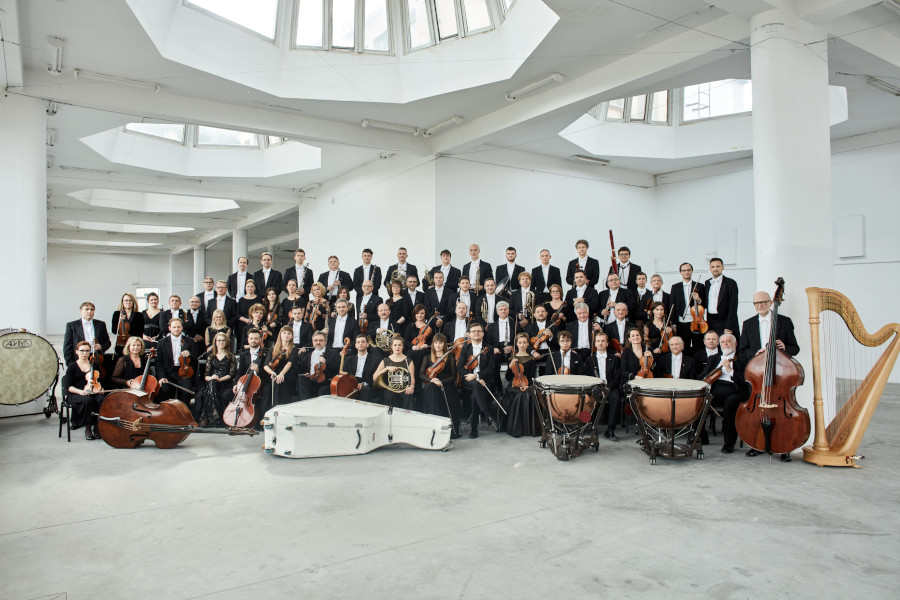
Pinchas Zukerman – a musical authority, violinist, violist and conductor who has delighted music lovers with his art for five decades – and Fumiaki Miura, who is dynamically developing his career after winning the International Joseph Joachim Violin Competition in Hanover in 2009, will perform with Sinfonia Varsovia. The orchestra is known, among other things, for its fruitful collaboration with Krzysztof Penderecki, their artistic director from 2003 to 2020. During the concert at the NFM, the musicians will present works by Bach, Mozart, Dvořák, and Kilar.
The works of the three European composers, which we will hear in the first part of the evening, are united by inspirations that reach beyond their homelands. Johann Sebastian Bach wrote many of his instrumental concertos under the influence of Antonio Vivaldi. The German maestro acquired a thorough knowledge of the Italian’s legacy while working in Weimar. The Concerto in D minor for two violins is an excellent example of these influences in the legacy of the genius from Eisenach. Scholars have written in this context not only about Vivaldi but also about Giuseppe Torelli. A glance at the work’s title is enough to uncover the underlying impulse behind Wojciech Kilar’s Orawa. The Polish composer evoked the folklore and landscape of the Tatra Mountains. The name itself refers to a region on the Polish Slovak border, neighboring Podhale, but largely within the borders of our southern neighbours.
The next composition we will listen to is Wolfgang Amadeus Mozart’s Symphonia Concertante in E-flat major. It was composed after the artist returned to Salzburg from a long journey that included stops in Mannheim and Paris. The trip undoubtedly sparked the Austrian’s creativity, who has been searching for new solutions in form and style ever since. This work is undoubtedly the result of such exploration, and Mozart’s powerful crescendos can be interpreted as a direct echo of his time in Germany. Unlike other works presented during the concert, Antonín Dvořák’s Symphony No. 8 in G major can be viewed by paying attention to the aspect of its history that connects it to a specific location – an estate in the village of Vysoká u Příbramě in Central Bohemia. The composer relaxed there, but also devoted himself to work, including on this work. It is characterised by joy and melodiousness, stemming in part from its references to folk art.