
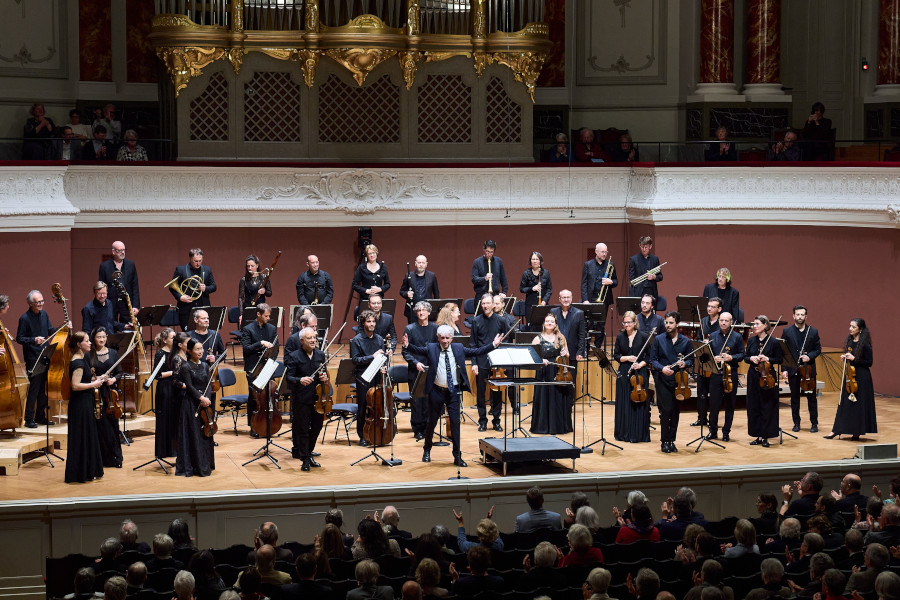
Giovanni Antonini is well-known to audiences thanks to his decades-long work with Il Giardino Armonico, which he founded in 1985. Since the 2015/2016 season, Antonini has also served as principal guest conductor of the Kammerorchester Basel. Both ensembles frequently meet under his baton, and this concert will be no exception. The conductor is currently working on a large-scale recording project – a recording of the complete symphonies of Joseph Haydn, to be completed in 2032, the 300th anniversary of the composer’s birth, so the inclusion of Haydn’s work in the programme should come as no surprise.
Haydn has been remembered as the father of two musical genres: the string quartet and the symphony. The latter will be represented by two of his London Symphonies. The concert will begin with the Symphony in D major Hob. I:96, known by the nickname “The Miracle”. This name refers to an event that allegedly occurred during the London premiere at the Hanover Square Rooms. As the enthusiastic audience gathered in front of the stage to applaud the composer, a chandelier tore from the ceiling. The ostensibly phlegmatic English demonstrated excellent reflexes – no one was injured. The last piece on the programme will be the Symphony in C major Hob. I:97, completed in 1792. Its slow introduction contains a quote from Wolfgang Amadeus Mozart’s opera Così fan tutte. Haydn attended rehearsals for the premiere of this work, and while in London, he received news of the death of his colleague, nearly a quarter of a century younger than him. In this context, the subtle stylistic allusions can be interpreted as a gesture of remembrance and tribute.
While Mozart’s operas continue to enjoy lasting popularity, Haydn’s stage compositions remain marginalised. The artists will perform excerpts from three of Haydn’s operas: L’anima del filosofo, or Orfeo ed Euridice, L’isola disabitata, and Armida. L’anima del filosofo was composed during the composer’s London trip, but due to rival intrigues, it never saw its premiere; it was performed only in 1951, with Maria Callas in the line-up. The fate of L’isola disabitata was also complicated – its score was not published until the 1970s. Haydn himself considered Armida, his penultimate opera, the most accomplished one. Join us to be thrilled by its charm.