
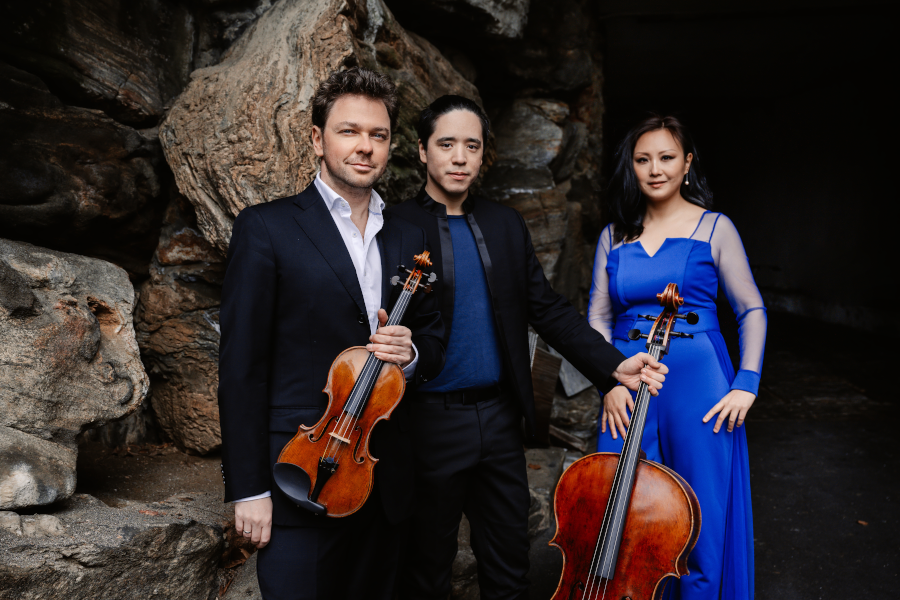
Two days after their recital, the Sitkovetsky Trio will reappear at the NFM, this time with the NFM Leopoldinum Orchestra. The meeting of the two ensembles sharing the talent of the famous violinist Alexander Sitkovetsky, will feature Czech repertoire. The light, Romantic pieces by Antonín Dvořák, such as Klid, will fill the first part of the concert. After the break, we will listen to the amazing Triple Concerto in C major op. 56 for piano, violin and cello by Ludwig van Beethoven.
Active for almost two decades now, the Sitkovetsky Trio is lauded by the critics for the distinguished coherence of musical personalities of its members. Apart from Alexander Sitlovetsky, artistic director of the NFM Leopoldinum Orchestra, the trio features Chinese pianist Wu Qian and German cellist Isang Enders. The group gained recognition thanks to their recordings of the complete Beethoven trios, produced from 2020 to 2024. They give concerts around the world, reaching for classical and modern works. The top-class instruments add to the trio’s artistry: we will hear a Stradivari violin and a Tononi cello. The evening is a wonderful occasion to listen to leading chamber players of our time in a trio line-up.
During the evening, we will find out that the lyrical aspect of Dvořák’s work continues to arouse interest. Silent Woods was originally a part of a piano cycle for four hands titled From the Bohemian Forest. The piano pieces became so popular that the composer decided to rearrange them for cello with orchestra. Of his other works, the Serenade – an early and light piece is often played. In it, he turned towards the Classicist aesthetic after a period of Wagnerian rebellion. It is hard to imagine a better occasion to admire an excellently harmonised piano trio than Beethoven’s Triple Concerto. The work, one of its kind, equals in its beauty his other pieces created at the same time: Piano Concerto in C minor and Violin Concerto in D major but of course differs from them in formal solutions. The majestic and at the same time delightfully graceful mood of the music in the third movement is evoked by its polonaise rhythm.