
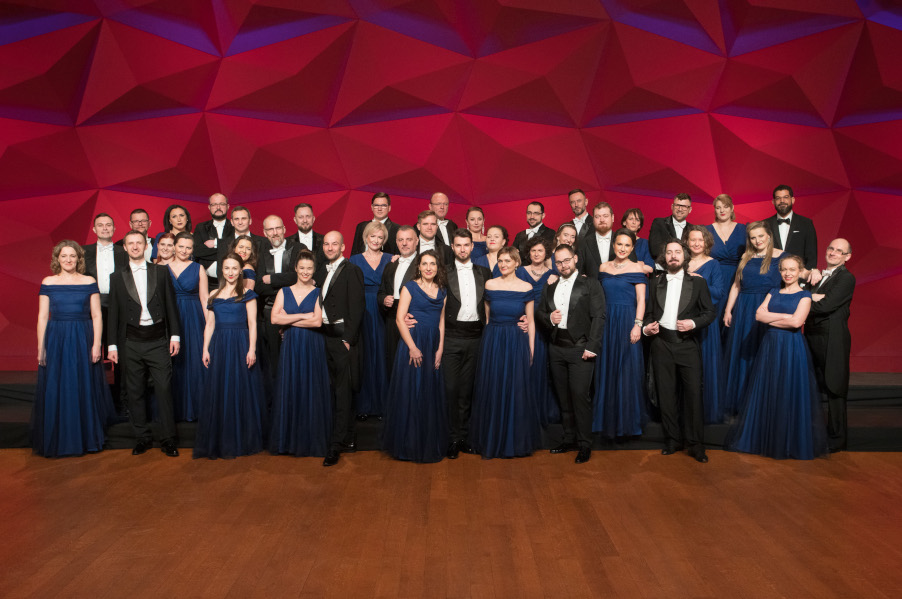
Wrocław is a space where music from various eras and traditions creates a coherent narrative. Sacred and secular inspirations, humour and reflection, locality and universality intertwine here into one story of many voices. This is perfectly demonstrated by the choice of pieces for this programme. From Wacław of Szamotuły, through Salamone Rossi, to contemporary composers such as Paweł Łukaszewski and Per Gunnar Petersson. Their pieces will be performed during the NFM Choir Season Finale. The musicians will be led by Artistic Director Lionel Sow, and Jean-François Zygel will join them on the piano, himself an improvisation virtuoso, renowned for his superb live accompaniments to silent movies.
The concert will open with an improvisation themed around Wrocław’s market square, performed solo by the pianist. Jean-François Zygel will evoke this part of the city as the starting point for a musical journey. He participates in various projects with musicians from around the world, at the most prestigious venues in France, Europe, Asia, and Latin America. He teaches a piano improvisation class at the Paris Conservatoire, which he founded in 2002. Following in the footsteps of Leonard Bernstein, he has gained particular popularity among the general public thanks to his programmes introducing listeners to classical music, broadcast on television and radio. His albums are released by Naïve and Sony. As the singers will present a cappella repertoire, the piano will become, as it were, a vehicle taking us to various places in the city. The choir will perform Była babuleńka by Romuald Twardowski, a composer strongly attached to tradition. Next, we will hear a work by Salamone Rossi, an Italian artist of Jewish descent active at the turn of the 17th century, at the boundary of the Renaissance and Baroque. In his choral work, he often drew on his native heritage, writing in Hebrew, which made him a unique figure in his era. Kaddish is a setting of one of the most important prayers in Judaism, whose main theme is the exaltation and sanctification of the Name of God. Japanese composer Tōru Takemitsu will take you into a completely different world of sound. Sakura, composed in 1994, celebrates the beauty of cherry blossoms. Its basis is a widely popular folk song, structured in such a way that a simple pentatonic melody is surrounded by clouds of dreamlike harmonies.
The programme also features works by Wacław of Szamotuły, considered the most important and best-educated Polish composer of the 16th century. He is a mysterious figure, as nothing is known about his training. However, it must have been thorough, and his craft masterful. In te Domine speravi is an exquisite setting of a psalm whose main theme is trust in divine protection in times of trouble. The Inkbottle op. 119 no. 5, is a short, witty song by the Anglo-Irish creator Charles Villiers Stanford – a renowned composer, conductor, and teacher representing the era of late Romanticism. The artists will also perform Andrzej Koszewski’s Ad musicam, in which the choir builds a vocal orchestra: hissing, whistling, clapping, and uttering a variety of surprising sounds. Koszewski is considered one of the leading authors of 20th-century Polish choral music. Paweł Łukaszewski is a renowned contemporary composer, conductor, and teacher. His Hommage à Edith Stein, based on German liturgical texts, consists of three movements, and dates from 2002. Just a year later, Per Gunnar Petersson wrote Omnia tempus habent. The title, meaning “Everything Has Its Time”, comes from the Book of Ecclesiastes, where the emphasis is on patience and acceptance of transience.