
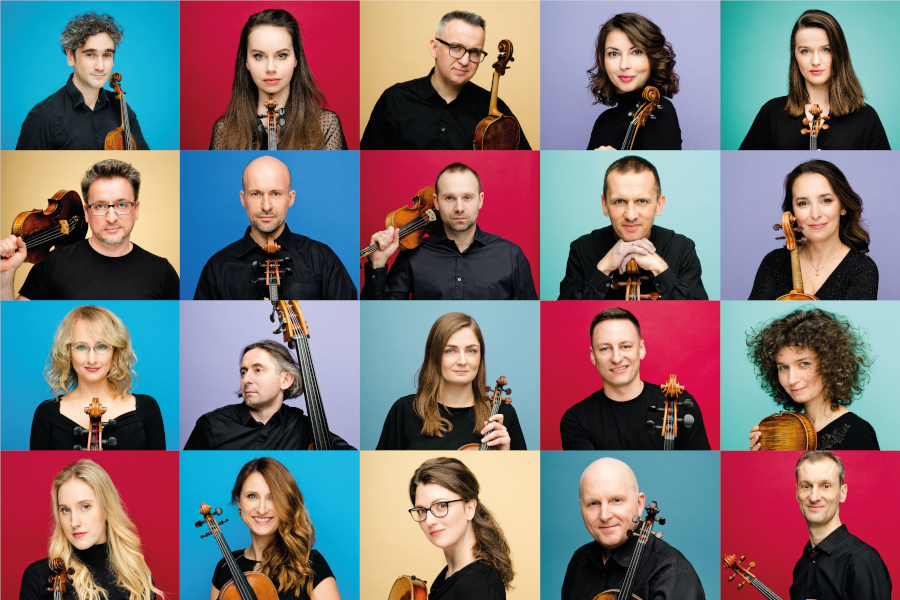
The NFM Leopoldinum Orchestra’s programme is built around serene Classical, Neoclassical, and Romantic works. Yet amidst this brightness, there is also a touch of poignant memories and the experience of loss. A contrasting note will be introduced by Aheym, a work by contemporary composer Bryce Dessner. An American context will return in the finale with Igor Stravinsky’s Concerto in D, the first work written after the artist became a US citizen. The evening will become a musical tale of home, emigration, and the search for balance across different eras. The ensemble will be joined by the outstanding young violinist Jacques Forestier, winner of the 2024 Joseph Joachim Violin Competition.
The evening will begin with a work from the Classical era. Joseph Haydn is considered the father of the string quartet and symphony, and his instrumental concertos are not as popular. However, they are on par with other Haydn’s works in terms of quality. A prime example is the bright and serene Violin Concerto in C major. It was created in the 1760s for the Italian virtuoso Luigi Tomasini, who, after achieving success in his native country, travelled abroad looking for a lucrative job. He found one at the Esterházy court, where he took the position of concertmaster. If contemporary accounts are to be believed, his performances of Haydn’s concertos aroused genuine enthusiasm among listeners. Edward Elgar’s Serenade in E minor for string orchestra is also an early work by the composer. Elgar wrote it for his wife, Alice, to celebrate their upcoming third wedding anniversary. It was composed in 1892 and first performed in a private concert the same year. The public premiere of this lyrical, contemplative work took place four years later. The Serenade quickly became one of Elgar’s most frequently performed works and the first with which the composer was fully satisfied.
The second part of the concert will open with Bryce Dessner’s Aheym, written in 2009 for the renowned Kronos Quartet. This dramatic composition was dedicated to the composer’s grandmother, Sarah Dessner. It told the story of the family members’ fate during World War II, their escape from Poland, and their search for their place in the world, which they found in Brooklyn. The work’s title means “homeward” in Yiddish. The programme will close with Igor Stravinsky’s Concerto in D, commissioned by Paul Sacher in 1946. The Swiss conductor wanted to celebrate the 20th anniversary of the Basler Kammerorchester he founded – hence the subtitle “Basle”. It was this ensemble that premiered the work a year later; the anniversary concert programme also included compositions by Arthur Honegger and Bohuslav Martinů, composed for the occasion. Stravinsky’s work is in the Neoclassical spirit – the music is full of serenity and elegance, and the narrative is enlivened by accents on weak bars and various articulatory techniques.