
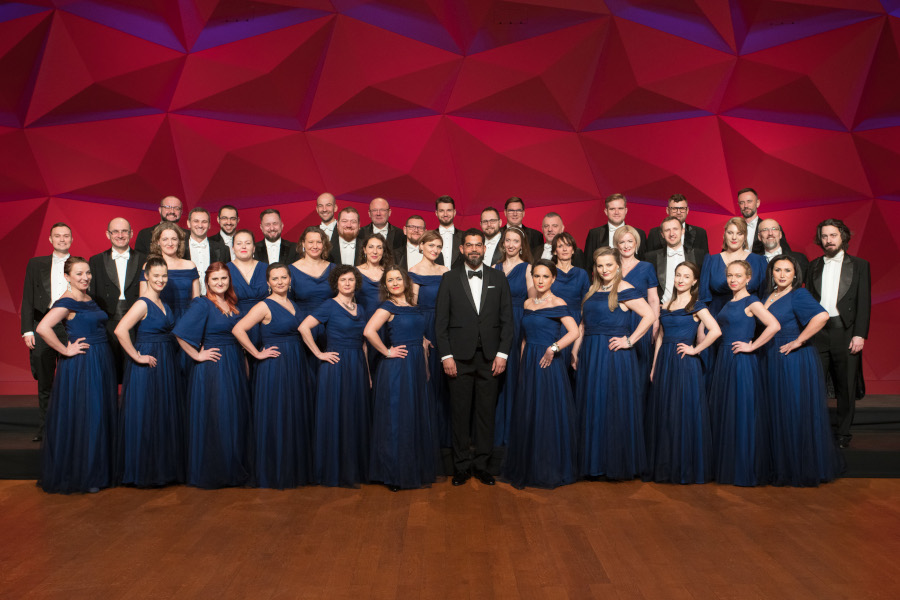
The achievements of late Renaissance Venetian music had far-reaching consequences for the history of music. During the concert in the Aula Leopoldina, the NFM Choir will focus on the German polychoral heritage of such composers as Johann Sebastian Bach, Felix Mendelssohn, Josef Rheinberger, and Johannes Brahms. The Baroque aula of the principal building of Wrocław University is, after all, one of those places on the city map where it is impossible to escape reflections on the past.
The evening will open with the motet Fürchte dich nicht, for double choir. This work was quite probably written for a funeral service held in Leipzig on February 4, 1726, although it may be older and was composed in Weimar. Using a variety of textures, Bach combined a text from the Book of Isaiah with fragments of a hymn by the Lutheran poet Paul Gerhardt. The Three Psalms op. 78 by Felix Mendelssohn were written during the intensely creative years of 1843 and 1844. The first element of the collection is based on contrasting sections – from passages filled with spiritual peace to the solemn tutti on the words You are my Son. The next section, based on the text of Psalm 43 (Give me justice, o God), is characterised by a simpler and more concise form. The following, deeply moving work opens with a tenor recitative: My God, my God, why hast thou forsaken me? – a call repeated by Christ dying on the cross. Throughout this composition, the chorus is contrasted by soloists and a separate quartet of singers.
Rooted in tradition, Josef Rheinberger’s work is today associated primarily with organ music. The Mass in E-flat major op. 109 remains his most prized choral work. In it, the composer draws on both Venetian polychoralism and the later German tradition. The heart of the composition is a concise Sanctus, sounding precisely as one might imagine the hymn of the seraphim sung at God’s throne in the biblical vision of the prophet Isaiah – the source of the liturgical text. The composer dedicated the mass to Pope Leo XIII and for this accomplishment was honoured with the Order of St Gregory the Great. The concert programme will close with Johannes Brahms’s Fest- und Gedenksprüche, written in 1888 and 1889 and relating to the composer’s honorary citizenship of Hamburg. The antiphonal settings of three motets, although inspired by the techniques of the Venetian school, also carry the political context of the era – reflecting the composer’s fear of a return to division in his recently reunited homeland.