
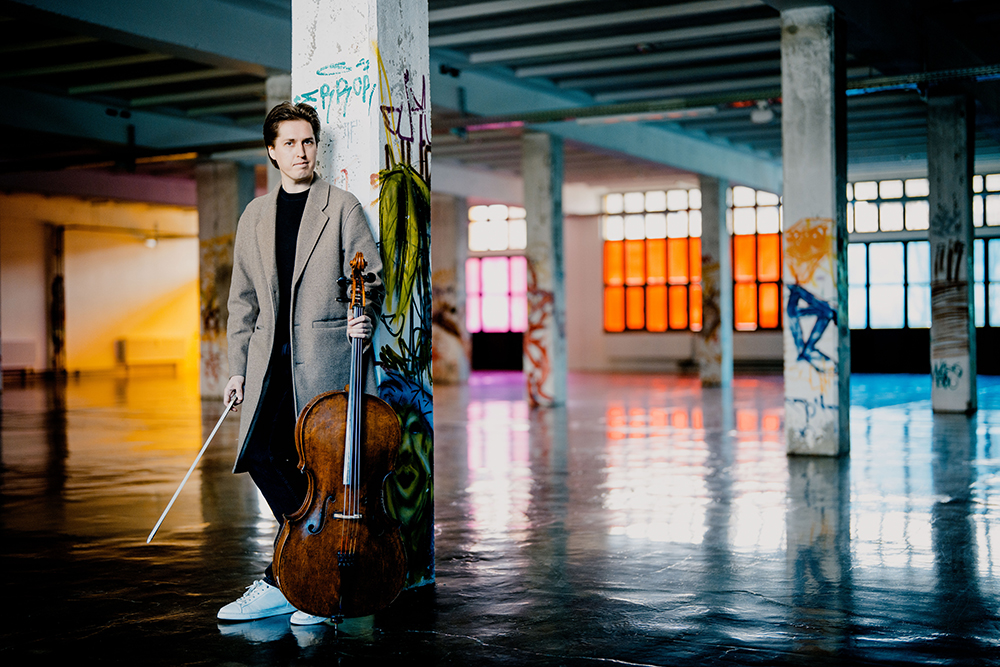
Born in Saint Petersburg in 1991 into a musical family, Alexey Stadler is one of the most exciting cellists of the younger generation. He made his debut in 2014 and has since performed regularly on international stages. During the concert at the NFM, he will be accompanied by Polish American pianist and teacher Adam Golka. The evening’s programme features works by composers who boldly forged new paths in music – Robert Schumann, Alfred Schnittke, and Fryderyk Chopin.
The concert will open with Robert Schumann’s Fantasiestücke. This three-movement piece was composed over just two days in February 1849, in a burst of extraordinary inspiration. The title aptly captures the nature of the music, in which sudden shifts in expression can surprise the listener. Gentle melancholy, lively dance, and finally, a moment of passion culminating in a triumphant apotheosis – this is the journey through the changing moods conjured up by the composer. Next will be Alfred Schnittke’s Cello Sonata No. 1, written in 1978 and dedicated to the distinguished virtuoso of the instrument, Natalia Gutman. The work has an unusual form: two slow movements frame a furious and energetic middle movement, in which echoes of the music by Dmitri Shostakovich can be found. It is a paradoxical composition. On the one hand, Schnittke draws on elements of classical harmony, but on the other, he presents them in an unconventional way, questioning their stability. One commentator compared listening to this sonata to visiting the ruins of a well-known building: once beautiful and impressive, today still recognisable, but evoking more awe and anxiety than security.
The evening will conclude with Fryderyk Chopin’s Sonata in G minor for piano and cello – a late work by the artist, inspired by his friend and distinguished cellist Auguste Franchomme. Work on the piece wasn’t smooth. “With my Cello Sonata – one moment I’m satisfied, the next – not. I throw it away, then I pick it up again...” the composer wrote in his letters. When he sat down at the piano in Paris in 1848 to premiere it with Franchomme, only three of the four movements were performed. The first movement was skipped because it failed to gain the audience’s approval during unofficial performances. Things later got even worse. Ignaz Moscheles wrote: “it seems as if Chopin were knocking on every key to see if he could find a good sound somewhere.” Only in the 20th century did this assessment of the piece change. Today, the Sonata in G minor is considered a mature work – deeply rooted in classical patterns, yet clearly looking to the future.