
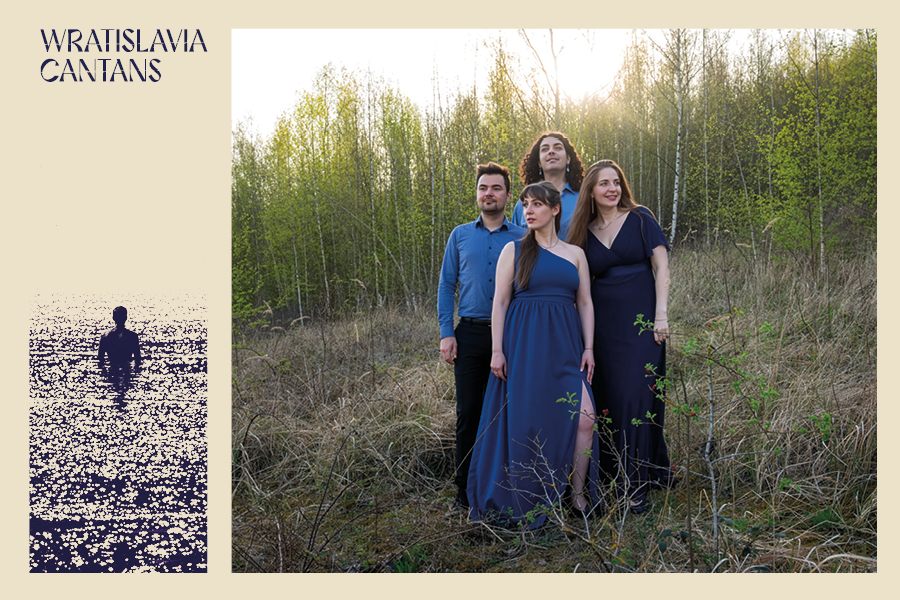
The motif of water – present in Samuel Barber’s reflective song and an exuberant shanty – unifies a programe that interweaves diverse musical languages and emotional worlds. From intimate melancholy, through irony and experimentation, to contemplation and spirituality – this multifaceted repertoire will be presented by Les 4 Sens, an ensemble selected in a competition for a musical project based on the theme of the 61st Wratislavia Cantans.
Samuel Barber was one of the most important American composers of the 20th century. The concert will open with a performance of his highly personal, short, melancholic piece, To Be Sung on the Water op. 42 no. 2, with lyrics by Louise Bogan – a story about mourning the loss of love and trying to come to terms with it. The piece was composed in 1968, as the composer’s nearly four-decade-long relationship with Gian Carlo Menotti was coming to an end. Barber’s oeuvre will also be represented by the Reincarnations op. 16, composed between 1939 and 1940. The artist drew on the words of the Irish poet Antoine Ó Raifteiri, known as the last of the wandering bards – a choice not accidental, considering his mother’s roots. Unlike later songs, these are imbued with passion and strong emotion. Darius Milhaud’s Deux Poèmes op. 39, date from 1916–1919. The pensive Éloge uses a text by the French poet and Nobel Prize winner Saint-John Perse. In Le Brick, the composer used a poem by René Chalupt.
The programme also includes the expressive, rhythmic New Zealand shanty Soon May the Wellerman Come – a story of perseverance, hard work, and hope, but also of the ruthless reality of life for sailors and whalers. Scotland’s Thea Musgrave is one of the country’s most important composers. The artists will present her On the Underground Set No. 2 (The Strange and the Exotic). It was written in 1994 and consists of four short sections: Dreams, I Saw a Peacock with a Fiery Tail, and The Subway Piranhas (at the end, the choir returns to the first section). The short, witty, and avant-garde Geographical Fugue from 1930 – Ernst Toch’s most famous work – will also be performed. The concept is simple: the choir sings the names of cities and countries, and the whole takes the form of a concise fugue. Henryk Mikołaj Górecki’s Three Lullabies op. 49 is contemplative music, full of peace and focus. It consists of Uśnijże mi, uśnij, Kołysz-że się, kołysz and Nie piej, kurku, nie piej. The premiere took place in 1991 in Lerchenborg, Denmark. The concert will be crowned with Benjamin Britten’s Ad maiorem Dei gloriam – a seven-movement cycle with texts by Gerard Manley Hopkins, written in 1939.