
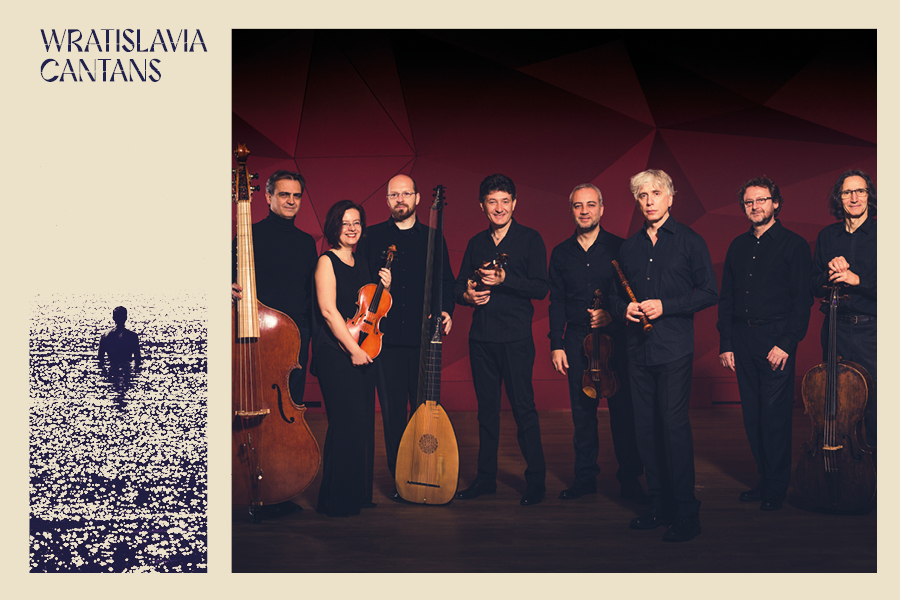
How Sweet Is the Torment is the title of the concert featuring Il Giardino Armonico, taken from an aria by Claudio Monteverdi. Early Baroque music written in Italy – the homeland of beauty – is pure sweetness. So where does suffering come from? Sì dolce è’l tormento and other vocal works will be performed by Angelica Antonini, and the ensemble will be led by flautist, music director, and former Wratislavia Cantans artistic director Giovanni Antonini.
Travelling with Il Giardino Armonico through early 17th-century Italy, we will visit the Duchies of Milan, Parma, Modena, and Mantua, the Republic of Venice, the northern reaches of the Papal States, and the Grand Duchy of Tuscany. The same green fields, the same cypresses and hills as today; only industry and highways are missing from this landscape. The journey promises to be slow, partly because we will be listening to the music of individual cities. We will begin in the Venetian lagoon, where we will hear a sinfonia from one of Claudio Monteverdi’s last operas, as well as several sonatas by Dario Castello, drawing on the idiom of the then new musical theatre. We will also hear a thought-provoking Sonata by the lesser-known Venetian organist Giovanni Battista Riccio.
Slightly to the south, in present-day Emilia-Romagna worked Marco Uccellini and Benedetto Ferrari, and the latter authored the aria Amanti, io vi so dire, framed on the ciaccona bass. Moving across the Apennines, we will stand at the foot of Florence’s Cathedral of Santa Maria del Fiore. Giulio Caccini spent most of his life in the Tuscan capital. His Amarilli mia bella, a hit well-known to early music lovers, will be performed in two versions: for flute and for voice. The melody was so popular that in the mid-17th century, the Dutchman Jacob van Eyck arranged it for flute. Moving on, we find ourselves in the cities of Lombardy. From the work of Cremona’s Tarquinio Merula, who worked for many years in Bergamo, we hear instrumental arrangements of the popular themes of ciaccona and ruggiero, as well as the moving lullaby of Our Lady, Or ch'è tempo di dormire. Milan’s Francesco Rognoni left behind a diminution of the Palestrina madrigal Vestiva i colli. Salamone Rossi, active in Mantua, modelled his work on Monteverdi’s early style, composing short Symphonies and Gagliardas. This brings us back to the composer of Sì dolce è’l tormento, which expresses an unquenchable desire for beauty...