
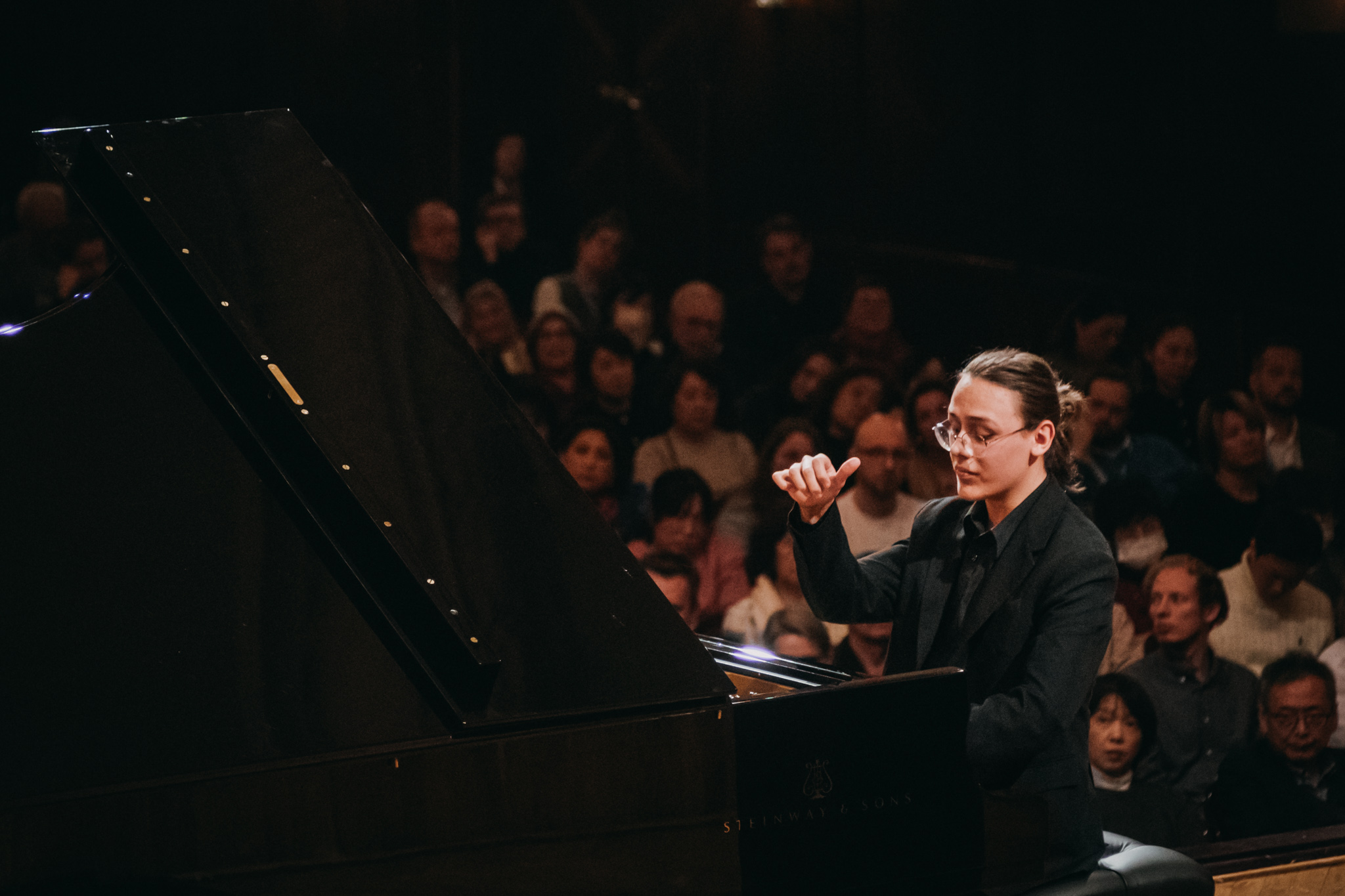
The NFM Orchestral Academy Finale will be a meeting of young project participants with musicians from the NFM Wrocław Philharmonic. We will hear works by Antoni Szałowski, Fryderyk Chopin, and Antonín Dvořák. The esteemed Georgian conductor Mirian Khukhunaishvili will conduct. Yehuda Prokopowicz, who captured the attention of audiences and critics at the 19th International Fryderyk Chopin Piano Competition, will join them for Chopin’s Piano Concerto.
The concert will open with Antoni Szałowski’s Overture, the latest of the presented works, written in 1936. It was composed as the culmination of Szałowski’s studies with Nadia Boulanger. It is a graceful, light, colourful, and witty piece, maintained in an accessible Neo-Classical aesthetic. After its Paris premiere, the French composer and music critic Florent Schmitt described Szałowski as one of the most talented composers of his generation, highlighting his melodic imagination and mastery of form. Next will be Fryderyk Chopin’s Piano Concerto in E minor. It is (along with the earlier Concerto in F minor) one of the most popular and distinguished works of this genre in the oeuvre of Polish composers. It is a piece full of virtuosity and brilliance, in the signature brillant style, which the young artist discovered while performing works by Hummel, Weber, and Moscheles. It is characterised by a distinctive, light, cheerful, and romantic aura, and its form follows the Classical model of a concerto. The maestoso first movement is based on the contrast of two musical ideas, the second is slow, atmospheric, and somewhat dreamlike, and the rondo finale is a stylisation of an energetic yet refined krakowiak. The virtuosic, ornamental piano part dominates the entire piece, performed this time by Yehuda Prokopowicz, while the orchestra’s role remains discreet, limited to accompaniment.
The final part of the programme will be Antonín Dvořák’s Symphony No. 7 in D minor. This dark, dramatic and tense work was written by the Czech composer for the London Philharmonic Society, the same prestigious organisation that had commissioned Ludwig van Beethoven’s Symphony No. 9 many years earlier. Dvořák was well aware of the enormous responsibility weighing on him, but he emerged victorious. The composition’s premiere under his baton in April 1885 was received with great enthusiasm. Although the composer is considered a representative of the Czech national movement, his Symphony No. 7 contains no references to Czech folk music.
Dofinansowano z Funduszu Popierania Twórczości ZAiKS