
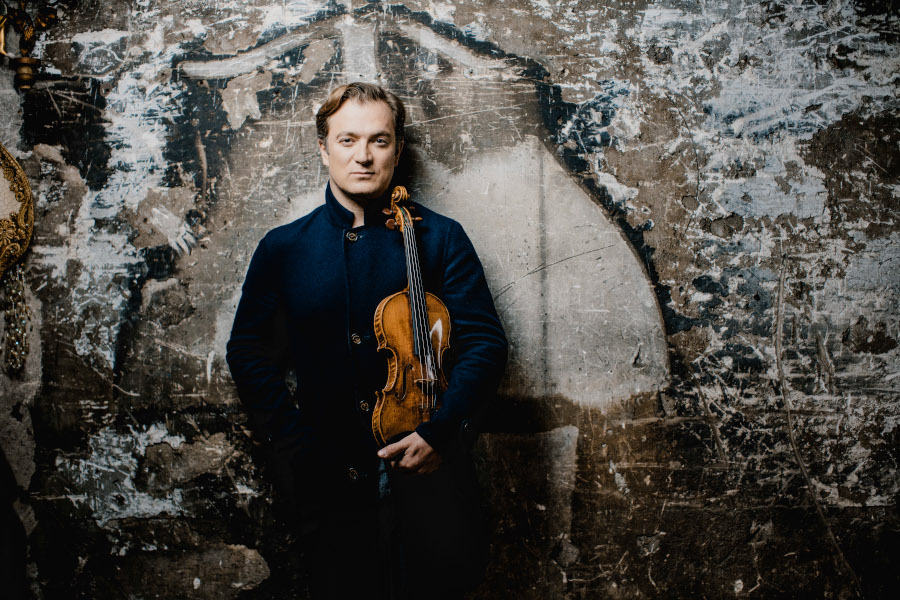
French violinist Renaud Capuçon will visit Wrocław for the first time, a musician whose recordings include collaborations with Martha Argerich, Khatia Buniatishvili, and his brother Gautier, a cellist. Accompanied by the NFM Wrocław Philharmonic conducted by Pascal Rophé, the musician will perform Jean Sibelius’s renowned Violin Concerto. In the second part of the evening, you will be treated to Alexander von Zemlinsky’s orchestral fantasy, The Mermaid, based on the famous Hans Christian Andersen fairy tale.
The most prominent Finnish composer, Jean Sibelius, intended to become a violinist in his youth. Instead, he became a composer, writing his only concerto for his beloved violin. Completed in 1905, the piece exemplifies the idiosyncratic yet Romantic style of the long-lived artist. Despite numerous virtuosic passages, a contemplative, austere, septentrional [i.e. referencing the North] tone dominates. The melodic themes are remarkably evocative and sincere, which gives the composition a special place in the hearts of many. Listening to the melodious sound of Capuçon’s violin in the 2025 recording of the work, you can gain some idea of what he will propose this time in the lyrical passages and dance-like finale.
Alexander von Zemlinsky is known mainly as the teacher, friend, and brother-in-law of Arnold Schoenberg. It must be admitted that the dodecaphonic school significantly overshadowed the achievements of the composer of The Mermaid, who remained faithful to Romantic ideals of beauty. Yet, the opening seascape of the narrative demonstrates that Die Seejungfrau deserves a place in the canon. Inspired by a fairy tale, the programmatic symphonic fantasy was written only two years before Sibelius’s Concerto. It is believed that von Zemlinsky’s work inspired by Andersen’s fairy tale was intended as a form of therapy after Alma Schindler abandoned him in favour of Gustav Mahler. Zemlinsky never published the score, which is full of passion and vivid imagery, and it was completed by musicologists only in 1984.