
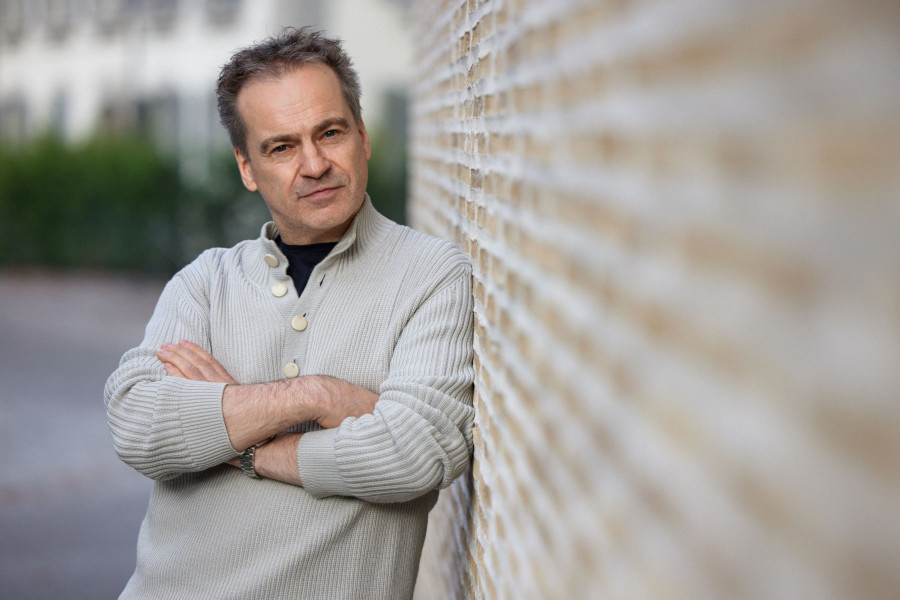
English conductor Jonathan Nott, recognised as a distinguished interpreter of contemporary music, will present a fascinating and unconventional juxtaposition of compositions by Mozart, Schönberg, and Kurtág during a concert with the NFM Wrocław Philharmonic and Choir. The programme encompasses works whose composition dates span nearly two centuries, from the Classical period to the 20th century.
The first work Nott will conduct will be Arnold Schönberg’s Friede auf Erden op. 13, for a cappella choir. The author was a founder of the Second Viennese School. In this early piece, completed in 1907, the composer drew on the text of a poem by the Swiss poet Conrad Ferdinand Meyer. He vividly contrasts minor keys with major ones, polyphonic sections with homophonic ones, and dissonances with consonances. In a letter to the conductor Hermann Scherchen, written in 1923, Schönberg characterised this work as follows: “It is an illusion for mixed choir, an illusion, because when I wrote this piece, I still believed that harmony between people was possible.” György Kurtág dedicated Grabstein für Stephan op. 15c, to the memory of the singer Stephan Stein. The work took its final form in 1989. It is scored for guitar and an ensemble of spatially arranged instruments. Unexpected dynamic shifts and a fantastic, unsettling timbre effectively capture the listener’s attention. The Hungarian composer is one of the doyens of contemporary music. He celebrated his centenary earlier in February.
The second part of the concert will feature Requiem – the last, unfinished work by Wolfgang Amadeus Mozart. It is a paradoxical piece. On the one hand, the composer reaches back to a more or less distant past. There are quotations from George Frideric Handel’s oeuvre, and the form alludes to Michael Haydn’s funeral mass. On the other hand, it is a surprisingly dark composition, full of violent emotion, anticipating the musical world of Romanticism. Over time, many myths have arisen around the Requiem. It was believed that Mozart’s death was caused by his supposedly jealous rival, Antonio Salieri, who allegedly poisoned him. It was also rumoured that the Austrian artist wrote this funeral mass for himself, sensing his imminent demise. In fact, the piece was commissioned by an aristocrat who had a habit of organising concerts during which he presented the commissioned compositions as his own. The extraordinary aura surrounding the Requiem even led to a bold theft. When the autograph of the work was displayed during the Brussels World Fair in 1958, a person, still unidentified, gained access to the manuscript and tore out a fragment containing the last notation in Mozart’s handwriting.