
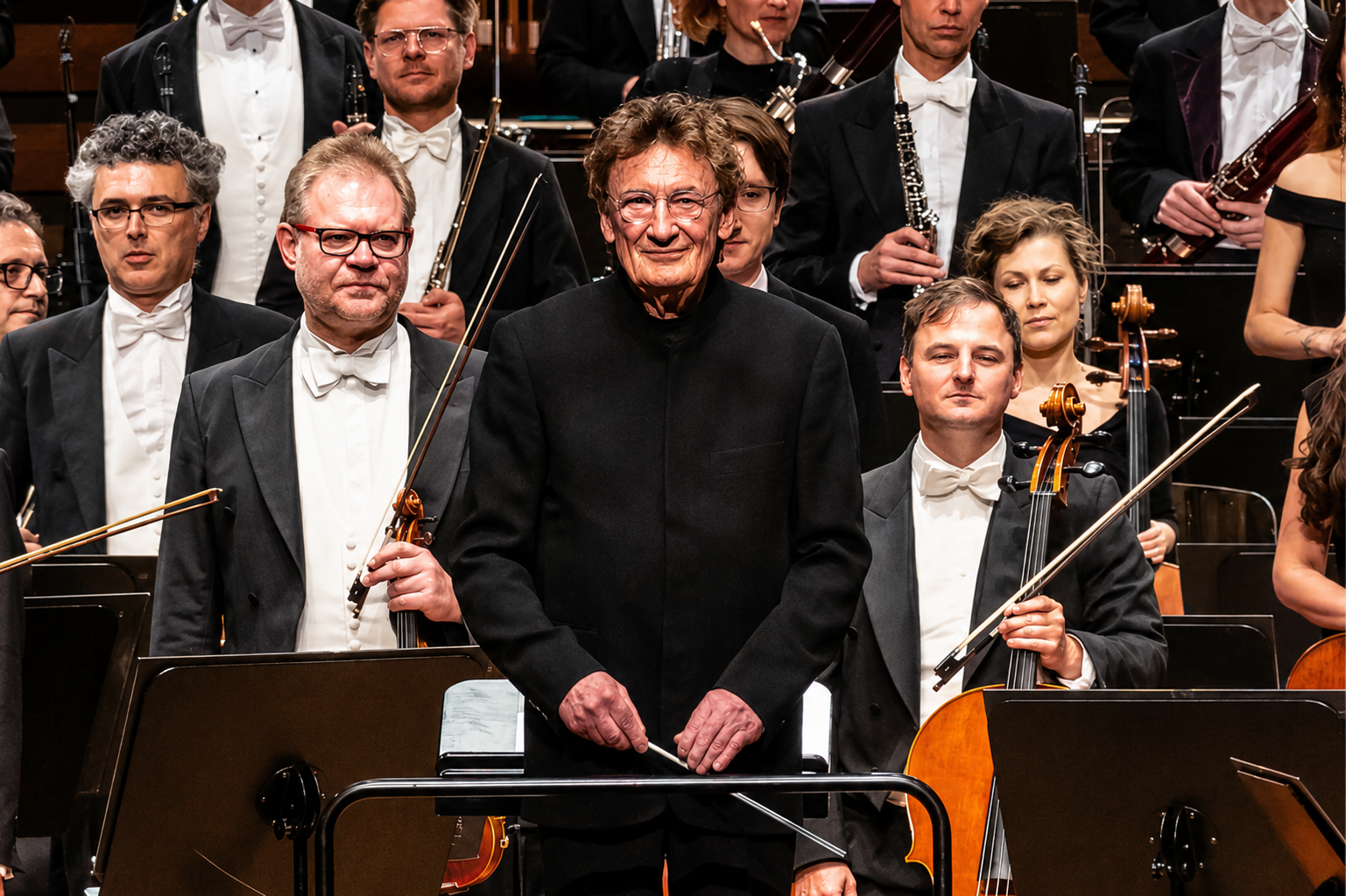
Jacek Kaspszyk – a conductor enjoying long collaborations with Poland’s most important orchestras and acclaimed internationally as an insightful interpreter of late Romantic music – will inaugurate the new artistic season of the NFM Wrocław Philharmonic, with Steven Isserlis performing as soloist. The evening’s programme features two works in the E minor key: Edward Elgar’s melancholic Cello Concerto and Gustav Mahler’s Symphony No. 7, the latter full of surprising contrasts.
Edward Elgar was a traditionalist uninterested in exploring new paths, and his musical language remained firmly rooted in Romantic aesthetics. The Cello Concerto in E minor is one of the artist’s mature compositions. Composed in 1919, it is often seen as a work that is a synthesis of not only Elgar’s work but also an entire era receding into the past after the dramatic events of World War I. Although the concerto genre is usually associated with virtuosic exploits, Elgar’s concerto is introspective, lyrical, and melancholic. An atmosphere of contemplation and tranquility prevails. It was written at a time when Elgar’s fame was waning, and therefore the work itself remained underappreciated for many years. A breakthrough came in 1965, when a recording with the then twenty-year-old Jacqueline du Pré was released. Her interpretation excited enormous interest in the work, continuing to this day. The solo part at the NFM will be performed by British virtuoso Steven Isserlis, one of the most distinguished cellists of our time. He plays the “Marquis de Corberon”, an instrument from the Stradivari workshop dating from 1726. He regularly performs with the world’s most important orchestras, and his recordings have won numerous awards. He is also the author of popular children’s books about the lives and works of great composers.
After the intermission, Gustav Mahler’s Symphony No. 7 in E minor will be played, representing a world widely different from Elgar’s concerto. It is a work radical in its musical language, full of elaborate, and at times deliberately exaggerated colour effects. Its unofficial subtitle is the “Night Song”. Although Mahler never accepted the name, he left numerous guidelines for the work’s interpretation. The persistent rhythm of the first movement is meant to evoke the rhythm of oars, the second was inspired by Rembrandt’s Night Watch, the third movement was ordered to be performed “shadowily”, the fourth has the character of a tender serenade with extended guitar and mandolin parts, and the composer summed up the pompous finale with the phrase: “The world is mine!” For a long time, the Symphony No. 7 remained on the margins of conductors’ repertoire. Only in the second half of the 20th century did it begin to be performed more frequently, and audiences have come to appreciate the originality and extraordinary richness of this work.