
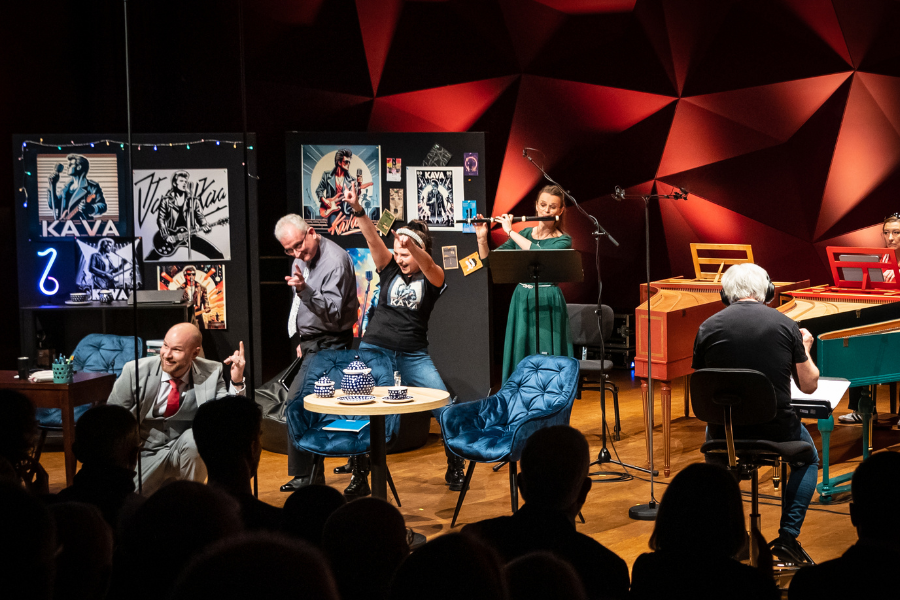
Johann Sebastian Bach and Georg Philipp Telemann are known primarily for creating music filled with seriousness and spiritual depth. This concert will demonstrate that both composers were also capable of exploring human weaknesses with a great sense of humour. The “Coffee Cantata” tells the story of a conflict between a father and a daughter, the latter being infatuated with the aromatic beverage, while Der Schulmeister is a travesty of a singing lesson involving talentless and mischievous students. Interestingly, the authorship of the latter piece remains uncertain. Wrocław Baroque Ensemble will be conducted by Andrzej Kosendiak.
The Schweigt stille, plaudert nicht BWV 211, commonly known as the “Coffee Cantata”, is one of Johann Sebastian Bach’s most cheerful and humorous works. It was composed with Leipzig’s Cafe Zimmermann in mind, where many of the composer’s other works have also premiered. The owner, wanting to distinguish his cafe from the numerous establishments serving the beverage that was all the rage in Bach’s times, began inviting the Collegium Musicum ensemble to play there. The idea proved a success: the audience eagerly combined musical experiences with a cup of coffee. The cantata is themed around the conflict between a father and a daughter. Schlendrian cannot accept Liesgen’s dedication to coffee, while she extols the delights of her beloved drink in an aria stylised as a declaration of love. The girl agrees to several other prohibitions so as not to have to give up the ritual of brewing the captivatingly fragrant beans. The situation becomes even more complicated when her father claims she will never marry. Yet Liesgen quickly finds a way to get her way: she secretly demands that her suitors accept that after the wedding, she will continue to prepare and drink coffee as much as she wants. Today, the cantata continues to entertain not only for its humour but also for its perverse take on the fashions of the era. It is worth remembering that women were not allowed to visit Cafe Zimmermann on a daily basis, and the concerts were the exception to this rule. Thankfully, the world has changed in this regard since then.
The protagonist of the “Der Schulmeister” cantata is an overbearing music teacher. He attempts to lead a singing lesson with a group of less-than-talented and unruly students. From the very beginning, he makes them repeat scales and explains the basics of music, while also making fun of those who do not understand it. He boasts about his own singing and conducting skills, though he admits that the results are not always excellent. The central section of the piece is a travesty of class: the teacher tries to teach his students complex polyphony, but the children keep erring, lose rhythm, and cannot count the bars. More and more irritated, the teacher explodes in anger, complaining about the students’ dumbness and claiming that they will make him sick or die of rage. However, everything ends on a cheerful note. There is also a moral: whoever does not love music and does not appreciate this art form “is and remains an ass”, a point emphasised by the performers’ comical imitation of a donkey’s bray. It is not entirely clear whether the work was actually composed by Georg Philipp Telemann. Some scholars attribute the cantata’s authorship to Christoph Ludwig Fehre, who lived at the same time.
The work undoubtedly penned by Telemann is the Overture-Suite in D major, which will precede Der Schulmeister. In a way characteristic of this composer, it blends elements of the French overture with the Italian concertante style, and the whole piece was created with a German audience in mind. The leading role in the composition is played by the viola da gamba, whose solo part will be performed by Julia Karpeta, an artist of Wrocław Baroque Ensemble. The composer employed appropriate means to ensure that the orchestra’s playing does not overshadow the viola da gamba unique, dark sound.