
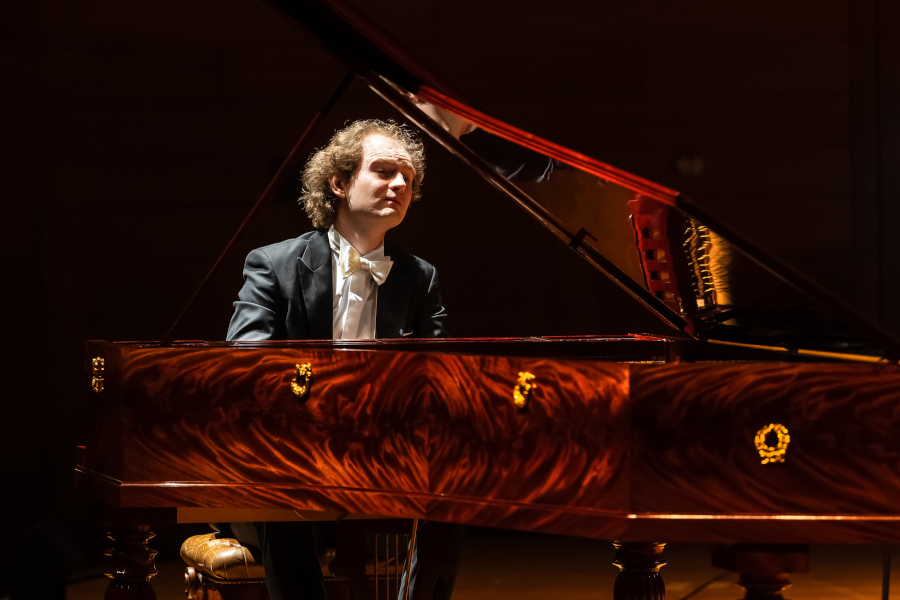
The meeting of Wrocław Baroque Orchestra and award-winning pianist Piotr Pawlak will be an excellent opportunity to hear two canonical works by Viennese classicists – Wolfgang Amadeus Mozart and Ludwig van Beethoven. The winner of the International Chopin Competition on Period Instruments play Mozart’s tense Piano Concerto No. 20 in D minor. The second part of the evening will feature the famous “Eroica” by the genius from Bonn. The concert will open with a piece by Karol Kurpiński, a composer who heralded the arrival of the Romantic era in Poland.
The evening will open with Kurpiński’s brilliant Elegy in C minor. The work has survived only thanks to an incomplete copy made before World War II. The full score was reconstructed by Jarosław Thiel, artistic director of Wrocław Baroque Orchestra, and subsequently recorded and released in 2020 on the album Kurpiński, Dobrzyński, Moniuszko. Immediately afterwards, the musicians will present one of the most spectacular pieces in Mozart’s catalogue. In the Piano Concerto No. 20 in D minor, Piotr Pawlak will perform the solo part. Although the Austrian composer wrote 27 works in this genre, it is this concerto from 1785 that fully demonstrates his brilliant and unconventional approach to the form. The composition has always fascinated other musical giants: Ludwig van Beethoven, Johannes Brahms, and Clara Schumann not only included it in their repertoire but also added their own solo cadenzas.
The concert’s second part will feature Beethoven’s Symphony No. 3, known as “Eroica”. The idea to create such a monumental work of unprecedented expressive power arose from the drama of Beethoven’s having to overcome adversity in order to pursue his art. He saw a kind of reflection of his own internal struggle in the figure of Napoleon Bonaparte. The artist believed the French First Consul, who was then conquering Europe, was a harbinger of a new political era and an end to feudal absolutism. Between 1802 and 1804, he wrote a symphony, which he originally titled “Bonaparte”. Disappointed by Bonaparte’s subsequent coronation as emperor, Beethoven changed his mind and rededicated the score: “A heroic symphony written in memory of a great man” – quite probably referring to himself.