
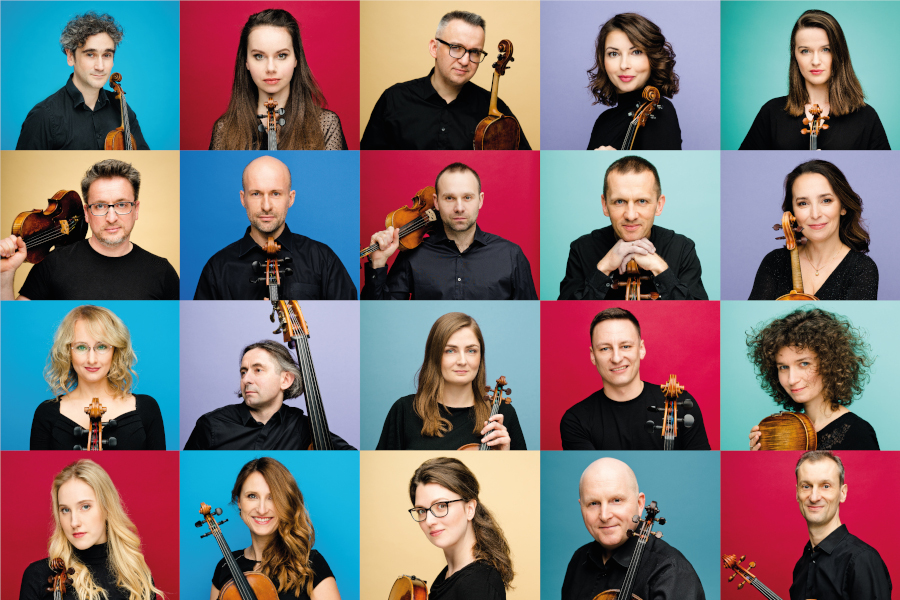
Can music serve as a lighthouse during the voyage that our life is? The NFM Choir and the NFM Leopoldinum Chamber Orchestra will try to answer this question. The artists will present compositions by Estonian composers Arvo Pärt and Erkki-Sven Tüür. In addition, they will perform audience favourites – Henryk Mikołaj Górecki’s Three Pieces in Old Style – and seek to reveal the hidden meaning behind a work by Johann Sebastian Bach. The NFM ensembles will be led by Lionel Sow and Alexander Sitkovetsky, respectively; the latter will also perform the Chaconne by the Leipzig Cantor. The entire programme will have a contemplative and mystical character.
The famous final movement of the Partita in D minor by Bach is a set of variations lasting about ten minutes, widely acclaimed as a masterpiece of the violin repertoire. According to the theory of musicologist Helga Thoene, the cycle contains implicit references to funeral themes that can be deciphered using numerological methods. Under this hypothesis, the Chaconne served as an epitaph for Bach’s first wife, Maria Barbara. Sitkovetsky’s violin performance will be accompanied by sung fragments of Protestant chorale melodies that Thoene identified within the score.
This unique highlight of the programme will be preceded by Henryk Mikołaj Górecki’s minimalist, archaizing Three Pieces in Old Style and Arvo Pärt’s Da pacem Domine, a hushed prayer for peace. The latter exists in various scorings; the version for choir and string orchestra, dating from 2006, will be presented at the NFM. The title of the Lighthouse, composed by Estonia’s Erkki-Sven Tüür refers to a guiding light that, to put it poetically, the music of figures such as the creator of the Chaconne casts amidst the darkness and foaming waves of history. In a unique tribute to the master, Tüür employs the Cross motif in the Lighthouse in various ways, one of the most significant rhetorical figures found in Bach’s body of work.
Following this turbulent yet sonically expansive maritime journey, the artists will soothe the audience’s mood with Arvo Pärt’s Berlin Mass. This contemplative work from 1990 premiered shortly after the fall of the Berlin Wall and German reunification. Although the composition, based on the famous tintinnabuli technique, was created for use in Catholic worship, it has not escaped the reach of pop culture: in 2015, the Kyrie was featured on the soundtrack of one of the Avengers films.