
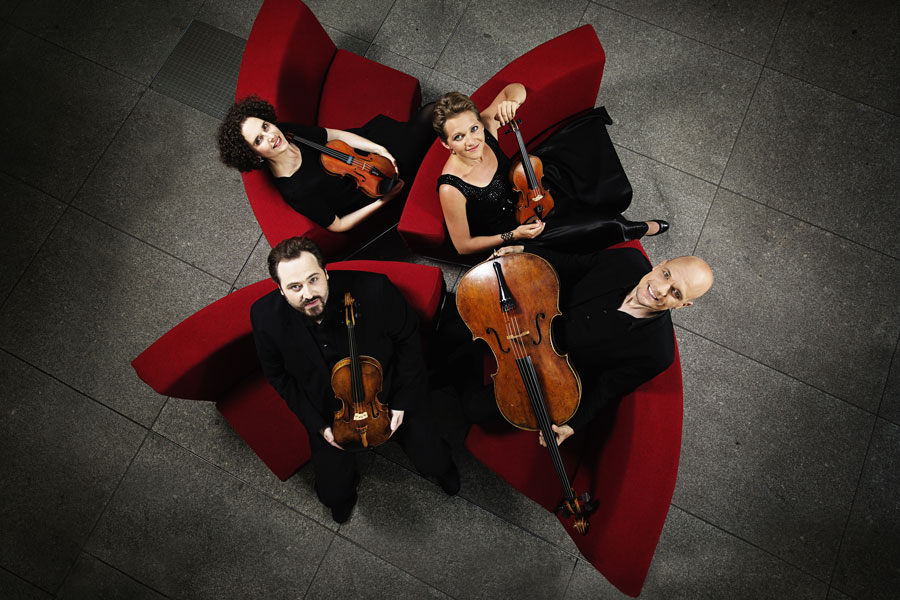
The Artemis Quartet was founded in 1989 at the University of Music Lübeck and is currently based in Berlin. In 2004 the ensemble established a series of performances at the chamber music hall of the Berlin Philharmonic. Since 2011, they have cooperated with the Wiener Konzerthaus and the Belcea Quartet and at the beginning of the current season, they also began appearing at the Prince Regent Theatre in Munich. Since 2005 the Artemis Quartet has recorded exclusively for Virgin. Their recordings have been awarded The German Record Critic’s Award, the Gramophone Award, the Diapason d’Or and the ECHO Klassik. Their complete recording of Beethoven quartets for strings was honoured with the Grand Prix de l'Académie Charles Cros, in 2011, and their album of Brahm’s quartets op. 51/1 and op. 67 received The German Record Critic’s Award in 2015. The ensemble, which also holds an affinity for new music, launched their own composition contest in 2015. All four members of the ensemble currently serve as professors at University of the Arts Berlin and Chapelle Musicale Reine Elisabeth in Brussels.
Ludwig van Beethoven's String Quartet in D Major, Op. 18, No. 3 was composed as part of a set of six quartets published in 1801. Though it bears the third place in Op.18, it was actually the first that Beethoven wrote. The D major quartet is one of the gentlest of the composers’ early works and of the six quartets in Op. 18, the work is the most genial and relaxed with a lyrical mood that is both bright and humorous. Although his early period quartets fall within his so-called "period of imitation," they are bold and masterful, often overflowing with invention, emotion and brilliant contrapuntal innovations. Op.18 is an example of Beethoven simply composing for string quartet in a manner worthy of Haydn and Mozart, both of whom he strove to emulate during this period.
Béla Bartók became obsessed with the folk music of his native Hungary in the first part of the 20th century and he spent forty years collecting, transcribing and codifying Central European and North African folk songs. "The question is, what are the ways in which peasant music is taken over and becomes transmuted into modern music?" he asked in a 1920 article.
We may, for instance, take over a peasant melody unchanged or only slightly varied, write an accompaniment to it and possibly some opening and concluding phrases… Another method by which peasant music becomes transmuted into modern music is the following: The composer does not make use of a real peasant melody but invents his own imitation of such melodies… There is yet a third way in which the influence of peasant music can be traced in a composer's work. Neither peasant melodies nor imitations of peasant melodies can be found in his music, but it is pervaded by the atmosphere of peasant music.
Bartók’s String Quartet No. 2 is an early example of this third method of incorporating folk idioms into concert music. The piece was composed in Rákoskeresztúr, outside of Budapest, between 1915 and 1917, during a period in which the composer spent most of his time organizing the information he had collected during the previous decade. "The whole direction of Bartók's later writing might be deduced from this one work," wrote Halsey Stevens in his biography of the composer.
Wolfgang Amadeus Mozart first mentioned Joseph Haydn in a letter on April 24, 1784. He and Haydn would have attended or performed together at the many musical celebrations that graced the Viennese social calendar. Mozart's greatest testament of respect for Haydn is represented by his set of six string quartets, which he composed between 1782 and 1785. The String Quartet in C major, completed on January 14, 1785, was the last in this set.
Mozart’s earlier quartets feature lighter, homophonic violin with accompaniment and he struggled to master Haydn’s more equal-voiced style. Thus, the writing of these six quartets represents an advance in compositional style. Within the set, the composer embraced the techniques of thematic development and thorough integration of the instrumental voices. Haydn had perfected this method in his Quartets, Op. 20 in 1771 and Op. 33 in 1781. Mozart’s inscription on the work read, “To my dear friend Haydn” with the mention that these pieces, “were the fruits of long and laborious toil.” Mozart’s struggles to master Haydn’s quartet style was, however, extremely rewarding. Critics and historians consider these six quartets more complex and harmonically richer than the Haydn’s Op. 33. It is also noteworthy that Haydn promptly responded with twelve masterful quartets of his own, Op. 50 & 54/55.
Alixandra Porembski, English Language Annotator