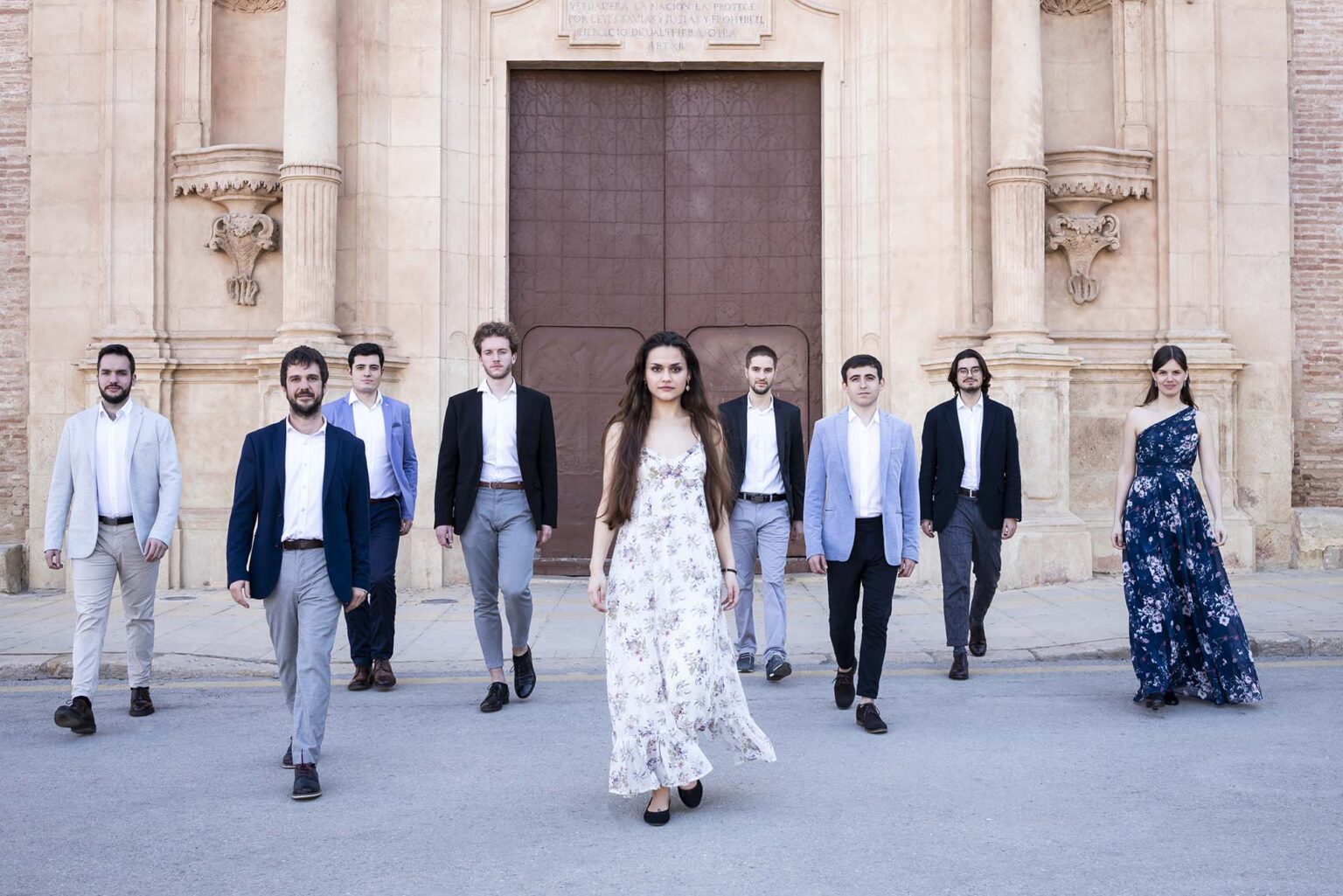
The Spanish Baroque villancicos and jácaras stand for a vivacious folk repertoire full of energy, crossing the boundaries between sacred and religious music. During the Spanish Academy opening concert, several examples of this music will be presented by the Cantoria vocal ensemble. It is not their first visit to the NFM. Directed by Jorge Losana, the group comes back in an extended line-up, already enjoying international renown.
Villancicos originally denoted musical forms functioning as refrains, taken from folklore or inspired by folklore. The practice dates back to the 15th century. Later, the name was used for entire songs with stanzaic forms. Their subjects were hugely diverse. In the 17th century, villancicos became a genre of religious music. They were performed in churches during services held on important church holidays. Among them, many were devoted to Christmas themes. In spite of their sacred function, they would often preserve their vivacious character, sometimes even accompanied by dance. No wonder that villancicos performed during liturgy met with opposition but it did not harm their popularity. The Cantoria’s ambitious programme combines the stylistic wealth of works coming from various periods and surprising with their diversity, expressive rhythms, paratheatrical forms, sometimes refinement, other times simplicity or wit.
The composers of the featured pieces were associated with the most important cultural centres in Spain – it was there that villancicos met with the greatest interest. José de San Juan, active in the first half of the 18th century and enjoying adulation during his lifetime, was responsible for music in Madrid’s royal chapel, next to become maestro di capilla in the Cathedral of Our Lady in Sigüenza. Joan Cererols was a monk at the Montserrat Abbey – a monastery known from the legends of the Holy Grail. José Martínez de Arce worked for the cathedrals of Segovia and Valladolid. He came across villancicos in his teenage years – the first confirmed record mentions him receiving an award of 50 reals for performing villancicos. Sebastián Durón tied his fortunes with the royal court in Madrid yet was expelled after he sided with the Habsburgs during the war of the Spanish succession in 1706. Guitarist Santiago de Murcia was a guitar teacher to the wife of Philip V, the first Bourbon on the Spanish throne in the aftermath of this war. Born in the 16th century, Mateo Romero hailed from Flanders. He came to Madrid as a young man and there climbed the ranks to become royal maestro di capilla, tellingly nicknamed “Maestro Capitán”.