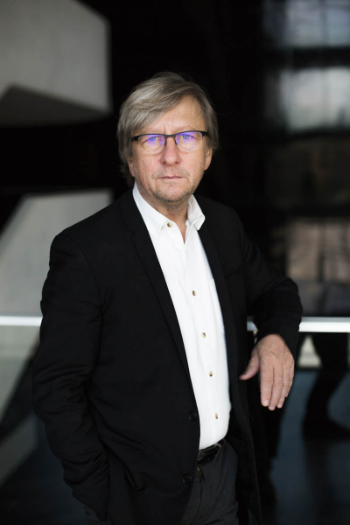
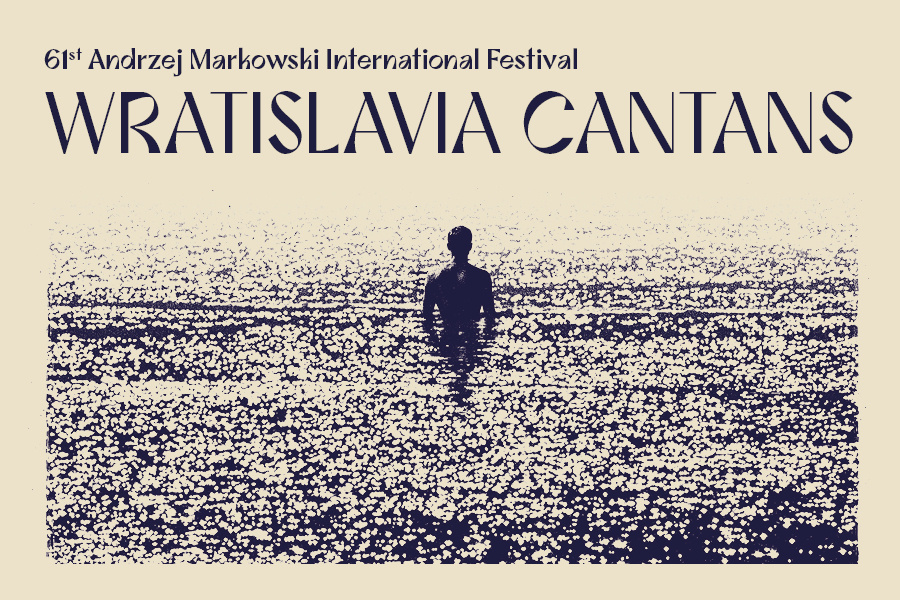
Szymon Atys talks with Professor Andrzej Kosendiak, Artistic Director of the Andrzej Markowski International Festival Wratislavia Cantans, about the programme of its upcoming 61st edition, decisions, maturity, and the passage of time.
As was the case last year, the theme of the upcoming 61st International Festival Wratislavia Cantans is inspired by literature. In his late novel, Joseph Conrad claimed that in every person’s life, “… one perceives ahead a shadow-line warning one that the region of early youth […] must be left behind”. A truly compelling theme – how should it be understood?
Professor Andrzej Kosendiak: Conrad’s title is a starting point for looking at situations in a person’s life in which they cross a boundary, where something ends and something else begins. The writer symbolically depicted the moment of leaving youth behind and taking full responsibility for one’s own life and the lives of others. I think we can imagine more such shadow lines along the paths we walk. One of them is the perspective of old age and transience. This phenomenon affects both individuals and various ideas, eras, and projects. I intuitively sense that we are living in a time of transition, that the world will no longer be the same. Are we capable of crossing the line into maturity?
A separate theme of Conrad’s novel is working together. The young captain dedicates his story to the crew, to whom he will “retain an undying gratitude for the rest of his life”.
I must admit that I myself am at a moment of life change, though of course the festival isn’t about me. I sense the end of some things and the beginning of others. Please note that the dedication to the crew is formulated long after the novel’s plot ran its course. The narrator, Conrad, could not have foreseen what would happen when he assumed the position of captain, with its consequences. His motto is an answer to a question posed before the plot began. Yes, it paid to be an adult, it paid to take responsibility.
Conrad’s work includes a quote from Charles Baudelaire’s poem Music:
Sometimes a vast, dead calm with glassy stare
Mirrors my dumb despair.*
Is this what the audience’s attitude should be?
We always leave it to the listeners what their attitude should be. The sea calm that fell on the crew was truly desperate, placing the characters in an impossible situation. However, we know that they managed to escape it. The strength of the novel, and with it the festival, is that it offers no definite solutions. Everyone must face the changes that occur in their lives for themselves. Sometimes we struggle to find our way in a new reality. Some people never grow up, others wrestle with old age or become depressed – during their existential sea calm, they sink into despair. Yet I encourage you, instead of passively waiting for the wind to guide your ship to a safe harbour, to ask questions and act...
Let’s move on to the protagonists of the 61st Wratislavia Cantans. A magnificent musical performance will be the concert version of one of Paul McCreesh’s most important projects: A Venetian Coronation 1595. One more artist will also revisit his legendary recording during the festival.
A Venetian Coronation is, in a sense, a sentimental journey. Paul McCreesh presented this project at the 32nd Wratislavia Cantans in 1997. That’s when I met him. The protagonist of the reconstruction of the coronation celebration, Marino Grimani, who received the title of Doge in 1595, was already quite old, yet he accepted the honour and the challenges it entailed. Venice itself, at the turn of the 17th century, while still magnificent and wealthy, was essentially in decline initiated by the conquest of Constantinople by the Ottoman Turks. Just as the Doge, La Serenissima had crossed the shadow line. The Il Giardino Armonico ensemble will revisit a recording from over thirty years ago during the Sì dolce è’l tormento concert. Giovanni Antonini is fond of travelling. But it’s also about a pilgrimage through life, including the “life” of our festival. McCreesh and Antonini are two former artistic directors of Wratislavia [Cantans]; I am the current one. They both certainly feel the gratitude that comes with fulfillment. Aboard the Otago – a sailing ship captained by Conrad – the game was played between humans and the forces of nature, and here the “forces of art” are the antagonist.
Two operas in concert versions will take us to the Mediterranean. We’re talking about Camille Saint-Saëns’s Samson et Dalila and Henry Purcell’s Dido and Aeneas. We see a symmetry in both titles. Is there anything else they have in common?
Oh, I didn’t know those operas were set at the sea! But they’re not maritime operas [laughs]. Both stories originated in Mediterranean culture. Their plots revolve around the theme of responsibility for oneself and one’s nation. Take the story of Samson, in Saint-Saëns’s work, which will be conducted by Thomas Guggeis. The Jews were oppressed and occupied by the Philistines. Although Samson initially succumbed to Delilah’s charms, he later consciously crossed the shadow line, prayed to God, and regained his strength, only to perish alongside his tormentors beneath the ruins of the temple. In this way, he saved his nation. The lovers in Purcell’s work are in a similar situation. The latter will be performed by the Capella Cracoviensis Choir and the Accademia Bizantina, joined by soloists. Such questions are also relevant to humans nowadays and will remain relevant to humanity in the future.
Let’s talk about Polish artists appearing for the first time or returning to Wratislavia Cantans.
We invited Jerzy Maksymiuk to celebrate his ninetieth birthday. He will conduct the NFM Wrocław Philharmonic and the NFM Choir. The maestro’s presence is incredibly moving for me. A strange story surrounds Ars Cantus – this outstanding Wrocław-based ensemble has never performed as part of the main Wratislavia Cantans event, only at an accompanying event! Its members have meticulously and consistently researched the work of Silesian composers, as well as the medieval period in general.
The NFM Leopoldinum Orchestra will also perform at this year’s Wratislavia [Cantans]. Joining its Artistic Director Alexander Sitkovetsky, will be a violinist highly regarded by Wrocław audiences, and the artists will appear together in chamber concerts.
The other violinist is, of course, Bartłomiej Nizioł. Together with Sitkovetsky, they are a pair of absolute virtuosos with contrasting personalities. In a cello duet, a Polish Cello Quartet member Tomasz Daroch will meet István Várdai. We’ll see the resonance of their energy and imagination. And surprise: both recitals will conclude with improvisation by the virtuosos! The chamber concerts will take place in small spaces. It’s a kind of festival stopover, a time for respite in the physical proximity of the performers.
The NFM Leopoldinum Orchestra concert will focus on Arnold Schoenberg’s Verklärte Nacht. The work was written in the 19th century, so it’s not about the emergence of dodecaphony or even a departure from tonality. However, it was here that the path began, along which the Austrian composer later took responsibility for something completely new, deciding to mature artistically in a radical way. With hindsight, we know that this work marked a complete breakthrough, but also the beginning of the end of the old musical world.
Traditionally, there will be an evening for contemporary music lovers, as well as Gordon Concerts and the Storms of Passion performed by the students, led by harpsichordist Marta Niedźwiecka.
The Oratorio and Cantata Music Interpretation Course is part of a long-standing collaboration with the Karol Lipiński Academy of Music in Wrocław. I’m delighted that Marta Niedźwiecka will be there. Perhaps she, too, is entering a new phase of her life [laughs]... She’s a wonderful harpsichordist, perhaps she’ll become a bandmaster? In this case, unlike in Conrad’s novella, there didn’t have to be an old captain’s intrigue, but a retired conductor from Wrocław consciously decided to offer her a concert [laughs]. The third edition of the festival’s Gordon Concerts will be titled Voyage into the Unknown – Agnieszka Grudzień-Gaczyńska, assisted by singer Magdalena Zawartko, will take children into the world of Conrad’s journeys. Contemporary music concerts at Wratislavia [Cantans] have a much longer tradition, one we are delighted to continue. This time, we invited the Cologne-based Ensemble MusikFabrik, whose programme features the premiere of a piece by Ukrainian composer Anna Korsun. Georgis Aperghis’s work includes an Orphic motif. This journey ends with a decision made under terrible circumstances, and the result is loneliness. This is the meaning of mourning.
In February, we announced the winners of the competition for a musical project related to this year’s festival theme. Can you tell us more about the winning ensembles?
We awarded the performers, but also their programmes, which had to be connected to the festival’s main theme. It is the artists who have conceived the repertoire they present. This year, two ensembles have won, considered excellent by the jury: BREZZA and Les 4 sens. They will be widely known someday. On the one hand, we have Baroque music and a star performer – soprano Maayan Licht singing works by George Frideric Handel; on the other, a vocal quartet performing 19th- and 20th-century music with staging elements – the musicians become, in a sense, actors.
So let’s go back to the festival director’s concert. You will be conducting cantatas by Johann Sebastian Bach.
Let me be more specific: two festival directors will perform during this evening. All Bach cantatas deal with human life and its condition. How did I choose them, and why, as a flutist, will Antonini accompany me? I once told him that I was approaching seventy and was facing a shadow line. I feel artistically mature enough to record my first album of Bach’s music! He responded with interest and immediately expressed his desire to play with me. The first such concert, performed by Wrocław Baroque Ensemble with his participation, Komm, took place in January 2025. Recordings of this repertoire will be released by the iconic Alpha Classics. The label has commissioned a whole series of albums featuring Bach cantatas for recorder from us! The material from the Herr Jesu concert will appear on the second album in this series.
In his Sixth Symphony, which closes the festival, Gustav Mahler expressed his personal fears, and it is said that he foresaw the existential catastrophes that awaited him. How do you perceive this work, and what message might it convey to the listeners?
Together with the Staatskapelle Dresden and Daniele Gatti, we hesitated between the Sixth and the Ninth. I chose “Tragic” because it was composed at a moment of transition – Mahler was facing a complete change: in 1907, he left the Vienna Hofoper, his daughter died, and he learned of a serious heart condition. The paradox is that this pessimistic work was written still during a happy period in his life. When we pass a given moment, we know it’s behind us. But before it happens, we still think the future might be different. A shadow line might be something that wasn’t meant to be. Returning to today’s world, one could put it this way: I fear that what we don’t want to happen is actually already happening. Will we know how to take responsibility for the future?
* Translated from the French by Roy Campbell (at: Poems of Baudelaire, New York, Pantheon Books, 1952)